
Kids’ conclave does research, picks a pope
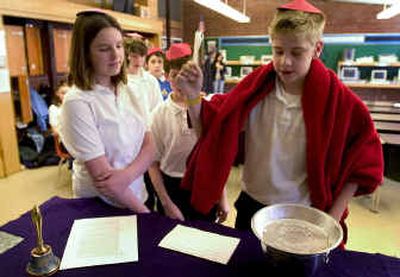
The bell rang amid the cheers as the door to the eighth-grade classroom flung wide open.
“Habemus papam!” announced Julia Chen, one of the students wearing red paper beanies on their heads. “We have a pope!”
Holding their own conclave Friday to elect the next pontiff, eighth-graders at All Saints Catholic School got a taste of the pageantry and centuries-old ritual that will happen next week as the cardinals choose a leader for the Roman Catholic Church.
Their teacher, Nick Senger, brought Rome back home for these 21 students, who spent the past week learning the pomp and traditions surrounding this historical event. The teens not only studied the background of the top candidates, they also convened an election, complete with oaths, rites and secret ballots. Each student took on the role of a cardinal, even taping or pinning a zucchetto – the skullcap worn by prelates – to their hair.
If this election had been the real thing, the next pope would be a black South African, a 64-year-old who grew up on a farm during the days of apartheid. Cardinal Wilfrid Fox Napier – aka Eugene Ng, age 14 – received more than two-thirds of the vote after four rounds, which took well over two hours.
Most eighth-graders attending Catholic school in the Diocese of Spokane usually learn about the church hierarchy from a textbook called “Liturgy and Morality.” But with the recent death of Pope John Paul II and current events in Rome, Senger knew he couldn’t ignore this teaching moment. Based on an idea from the Archdiocese of Washington, D.C., Web site, Senger put together several lessons that provided students with information on the cardinals and some of the history surrounding the papal election. He wanted them to gain a sense of the cardinals’ responsibilities to Catholics worldwide, he said, as well as experience the many rituals involved.
One big difference, however, between the actual conclave and the eighth-graders’ election was media access. While Senger and his class allowed reporters and outsiders to view the process, the cardinals have been sworn to secrecy and their vote takes place behind closed doors.
“Just don’t talk to anyone on your way down,” Senger joked when he sent Kaylie Pierce to the school office with the headcount for the day’s orders for hot lunch and milk.
“I’ll be excommunicated,” replied Pierce, whose role was that of Cardinal Marc Ouellet, of Canada.
The mood became more serious minutes later when Senger asked the students to sing the opening song, “Come Holy Spirit,” with the same solemnity as though it were a prayer.
“We have to pray for the cardinals to receive the guidance of the Holy Spirit as they elect the next pope,” he told the students. He also asked them to portray their roles with reverence.
During the week and between voting rounds, the students also had informal discussions about whom to elect.
“We need someone from Africa,” Tucker Clarry told his classmates during a break. The 14-year-old, who wrapped a red fleece blanket around his shoulders to match his paper skullcap, said an African pope would understand the needs and concerns of the large number of Catholics living in developing nations.
“You have to choose what’s best for the world,” said Clarry, who was Cardinal Francis Arinze, of Nigeria, for the day.
“We’re not looking for an activist but a realist,” explained Richie Godsil, who played the role of the Belgian cardinal, Godfried Danneels. “Someone who can bring the whole church together.”
After swearing on the Bible, each “cardinal” wrote a name down on the ballots that stated, “Eligo in summum pontificem” – “I elect as supreme pontiff.” One at a time, they walked toward the altar at the front of the classroom with the ballot, folded twice, in hand.
“I call as my witness Christ the Lord who will be my judge, that my vote is given to the one who before God I think should be elected,” recited each cardinal before placing the piece of paper into a receptacle – in this case, a round baking pan, which they then turned over so the ballot fell into an aluminum mixing bowl.
The names on the ballot were then read out loud by the scrutineers, chosen among the cardinals, who pierced each ballot through the word “Eligo” with a threaded needle. Although a fire wasn’t lighted during the classroom election, the cardinals’ ballots are traditionally burned. Black smoke signals that a pope has yet to be elected. White smoke indicates the cardinals’ work is done.
For the eighth-graders at All Saints, a bell that rang shortly after noon became the substitute for smoke. The sound came with much relief since it took four rounds for two-thirds of the class to vote for Napier. Some feared they would be divided into two camps – those voting for the South African and others who sided with Giovanni Battista Re, the Italian “insider” – and that the election would take all day. But it was nearing lunchtime and inevitably, the cardinals got hungry.
“Habemus papam!” The announcement was greeted with applause.
Asked what he wished to be called as pope, Ng paused. “Gregory … the fifth?” he said, unsure about the number of Pope Gregorys who existed before him.
The remaining cardinals removed their beanies, walked up to the new pontiff and bowed their heads.