
Ideas are booming
NEW YORK – The baby boomer market is so lucrative that entrepreneurs are literally competing to capitalize on it.
At the 2005 Boomer Business Summit, held last month in Philadelphia, 40 contestants vied for a $10,000 prize in the Boomer Business Plan Challenge. The finalists ranged from a company that makes a high-tech knee brace to a low-tech moving company.
The competition was organized by Santa Clara University, the American Society on Aging and Mary Furlong, a consultant to businesses that want to market to older people.
The stakes for the contestants are huge – more and more money is in the hands of people who are likely to spend on reading glasses rather than the latest computer game. People over 54 had more than twice the net assets of younger people in 2001, according to the most recent Federal Reserve data.
And they have needs that businesses have overlooked, according to David Yarnell, one of the judges at the competition. Yarnell said teenagers and young adults are already well served, so entrepreneurs should be focusing more attention on the needs of older people.
“It’s not as sexy, but people are realizing it’s a very, very powerful marketplace,” said Yarnell, managing partner at venture capital firm BEV Capital in Stamford, Conn.
Here’s a look at four of the finalists:
The PowerKnee
Millions of seniors have trouble walking due to diseases like Parkinson’s, injury, surgery or just plain age. So engineers Kern Bhugra and Robert Horst developed the PowerKnee, a motorized brace that fits over the knee, and won the $10,000 top prize at the competition.
The device, still in the prototype stage, uses sensors along the leg to figure out the wearer’s intentions, then starts its powerful electric motor to help the movement along.
“It really takes some of the load off the quadriceps and puts it on the device,” Bhugra says.
To make the PowerKnee small enough to fit under clothes, Bhugra’s small company, Tibion Corp., plans to use a patented motor with sliding, electrically charged plates which fit flat along the leg.
Bhugra said the PowerKnee could be on the market in a year and a half, provided Tibion, based in the San Francisco area, finds funding. It would probably cost $5,000 to $6,000, slightly less than today’s custom-fitted knee braces.
Furlong said inventions like Tibion’s are important because the baby boomers are physically active and will want to stay that way as they get older.
Movers of the elderly
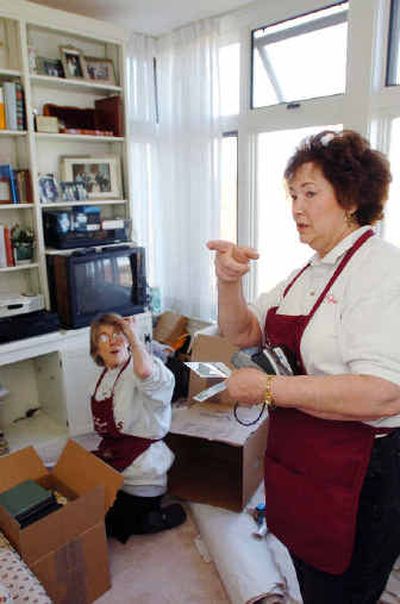
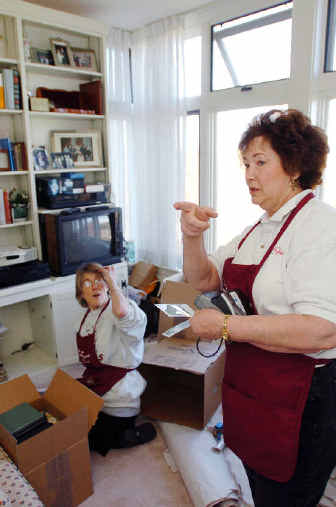
Moving is tough when you’ve lived at a place for 40 or 50 years, particularly since that often means moving to a retirement home or apartment where you have less space. A new industry has popped up to help out: senior move managers.
Margit Novack, of Wynnewood, Pa., founded Moving Solutions in 1996 and has 20 affiliates in other cities. She hopes to expand through franchising.
One of the services her movers provide is that before the move, they draw up the layout of the new home on a magnetic board and let the customer position cutouts representing the furniture.
The digital life story
In 1994, Beth Sanders interviewed her grandmother about her life, and realized that the connection she established with past generations of her family was a rare thing in the modern age.
“People are so spread out,” the Sanders says, “and parents and grandparents know a lot information about their parents and grandparents that never gets passed along.”
The Marysville, Ohio, native turned that realization into a business idea, creating a Web site, www.lifebio.com, that walks customers through creating a life history of their parent by asking questions such as how he or she spent a summer day as a child. They can also upload pictures.
The finished product is a digital file that can be downloaded and printed. For an added fee, Lifebio will print it as a hardback book.
The site launched in 2001 and has had 4,000 customers. Sanders said she hasn’t done much marketing, but that will change this year.
“I’m seeing the baby boomers especially as the market,” she said.