
Road warrior logs his millionth mile
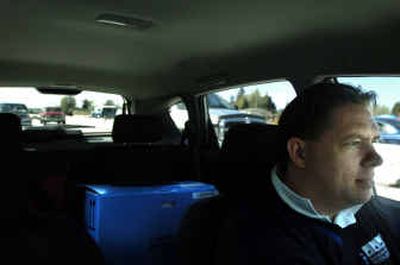

As he drove over the Montana state line April 7, Michael Roe had one eye on the odometer of his Chevrolet Cavalier and one on the rock piles along the U.S. Highway 2 shoulder.
This was a day 15 years in the making, one buoyed by a lot of blood, sweat and, well, urine, really, more than sweat. Roe, 41, is a rural route driver for Pathology Associates Medical Laboratories. He logs more than 1,300 miles a week collecting bodily fluids between Spokane and Troy, Mont.
On this trip, two miles after crossing into Montana, Roe reached his millionth mile as a courier. He found the rock pile he was looking for and a flat stone, slightly bigger than a license plate, to record his progress. He’d been counting the miles like an atomic clock counts minutes.
“I had it right down to the day, to the time almost,” Roe said. “I drive about 285 miles a day. At one time, I drove 430, back and forth to Bonners Ferry (Idaho) two times a day.”
Roe not only counted the miles, but he also translated them into transcontinental, even orbital, trips he could have taken instead. He could have circled the world 40 times, made two round trips to the moon, driven to every Washington State University home football game for 1,041 years.
“He’d come in every once in a while and tell us he could have driven to New York or Paris or been around the world,” said Maggie Winkler, Roe’s boss.
But Roe hadn’t gone around the world. He’d done what many of us do who speed through Spokane Valley on Interstate 90 daily, albeit on a much larger scale. Roe had retraced the same pattern five days a week, year after year. The adventure wasn’t exotic, but it was Roe’s; it was his life.
Scribbled in a small black pocket calendar were the details of those miles, the more than 26,604 gallons of gasoline he’d purchased, the 661 deer he’d swerved to miss and the seven he’d hit, the five flat tires and the two times his car had broken down.
Not in the book were the people he had met in the small towns along the way. Roe is a runner. On his lunch breaks, he’d pull into places such as Bonners Ferry or Sandpoint, change into his shorts and running shoes and jog.
Locals assumed he was just a neighbor running down the road. They called him “Mike” at the grocery store, asked him if he would be attending their town’s summer festival, which Roe often did.
The town doctors and medical assistants knew who he really was, but no one else did – and Roe seldom let on. He liked the sense of belonging he received in the small towns, a sense he never really got in sprawling Spokane.
And he didn’t bother to write down his feelings about the thousands of specimens packed in coolers and stowed in the Cavalier’s trunk. Sure, there were blood vials and urine cups, sometimes even body parts, but more than what they were physically, the samples were burning questions about everything from HIV to pregnancy. Every night, Roe’s cargo would be processed with 7,000 other samples from at least four other states so answers could be delivered in the morning.
“You know that every single sample is the most important thing to somebody,” Roe said. “Their very life may be in that sample. Maybe a guy has hepatitis; maybe a woman doesn’t know what’s wrong with her and needs to know.”
Sometimes, on a million-mile trip, it’s the small steps that matter most.