
New Relay targets non-minivan niche
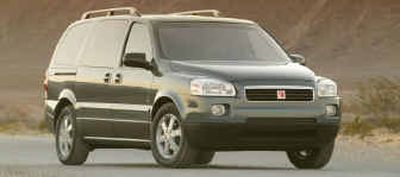
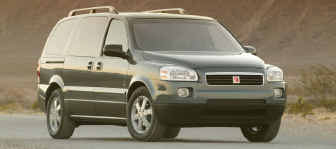
For a full week, I pondered the strategy behind the Saturn Relay before a uniformed representative of the U.S. government finally spelled it out for me.
“What is that?” the mailman asked as I filled ‘er up at the corner station.
“Saturn’s new minivan.”
“Wow, I like that.”
He took a closer look.
“But it doesn’t look like a minivan.”
“I know. That’s the idea; they put a sport-ute front-end on it for people who don’t like the way minivans look.”
“Great! I’m going to have to show that to my wife.”
And so it was that the veil fell from my eyes: Maybe Saturn was onto something. By stitching a truck-like hood to the front of its new Relay, the company hoped to attract a new set of buyers to the minivan fold.
Soccer moms, perhaps, but soccer moms (and their hubbies) who need the room of a minivan but shun the stigma.
Is there a more obvious symbol of domesticity?
Minivans were the automotive fad of the 1980s and the savior of the then-ailing Chrysler Corp., which unleashed them on the world in 1983. With seating for up to seven and flexible seating/storage arrangements, they answered the prayers of hundreds of thousands of families.
But in time domesticity gave way to a sterner brand of lifestyle in the guise of the sport-utility vehicle; now, the minivan market has stabilized at about 1 million annual sales. Chrysler remains a top dog in the market, along with Honda and Toyota, while GM sales have traditionally lagged behind.
At this point, the market isn’t large enough to justify a bottom-to-top minivan makeover, so GM has cleverly reconfigured its van fleet as a new kind of hybrid. GM calls them alternatively “mid-vans” or “crossover sport vans,” but let’s just call them what they are — minivans for the minivan-phobic.
The Relay is available in two configurations — front- and all-wheel-drive — and two trim levels, known simply as Relay 2 and Relay 3. Pricing begins at $24,485 (including destination) for a FWD Relay 2. All-wheel-drive iterations start at $30,570.
This is Saturn’s first van — it has in the Vue a small sport-ute, and, as Saturn’s first steel-bodied vehicle, the Relay departs from tradition.
It’s also the first sortie in a new-product-release assault that over the next three years will double the number of segments in which Saturn competes. Up next is the Sky, a sprightly little roadster that will introduce a new front-end design theme destined ultimately for all Saturns. Following the Sky will come the Aura, an up-level sedan designed in Europe and outfitted to European standards by GM’s Opel division.
Built on a car platform, the unibody Relay offers car-like ride and handling. It rides an inch higher than previous GM vans and, despite the SUV proboscis, has all the amenities of the modern minivan, including a DVD-based entertainment system, which is standard on every Relay built.
The entertainment system is part of a unique powered-rail overhead console that accommodates interchangeable storage and entertainment components. One option is the 40-gigabyte “PhatNoise” mobile digital media that allows owners to store and play back thousands of MP3 audio files and/or a movie collection.
Family matters count big-time here: In addition to the DVD player, even the base Relay 2 incorporates an eight-speaker sound system with CD/MP3 player. A 115-volt AC outlet powers video games and the like. Other standard gear includes power windows, air conditioning, cruise control, keyless entry and the OnStar communications system.
Anti-lock brakes are standard, but side-impact airbags are optional and curtain-style bags are not available, which is likely to prove a miscue in the family market.
The Relay seats seven and the third-row seat is split 50/50 for increased cargo-hauling flexibility. Because of space limitations imposed by AWD, GM couldn’t design the rear seats to fold into the floor to create a flat cargo-area surface. Both second- and third-row seats fold, though, and can be removed. An optional cargo-area storage system provides crush-proof safety for small and fragile items and security from prying eyes.
The interior is without question the best yet from Saturn, with solid-feeling switchgear and materials that look good and feel good to the touch. There’s ample storage room, including jumbo compartments appended to each seatback.
The Relay is somewhat narrower than its prime competitors, reducing cargo space incrementally, but Saturn has made sure the space that’s there is useful.
On the road, the Relay is stable and surefooted. Its long wheelbase helps create a smooth ride and the steering is reasonably accurate, if not particularly quick or well-weighted.
Front-wheel-drive versions can be ordered with optional traction control, a big help in slippery conditions.
The only power plant offered is GM’s venerable, 200-horsepower, 3.5-liter pushrod V-6, which is mated to a four-speed gearbox. It’s an adequate powertrain, but not much more than that. During a drive north through Bonners Ferry to the Canadian border, I found acceleration to be lacking at passing speeds. On long, uphill slopes, the transmission quickly found its gear and held it, with no annoying hunting through the gears.
As for that styling, it is, as always, a subjective matter. With its strong hood and blunt front end, the Relay looks for all the world like an SUV up front. But the passenger doors are sliders, a true giveaway to its real personality, and the slider tracks remain visible.
Regardless, as my experience with the man with the mailsack proves, there appears to be a market for this unusual hybrid. If Saturn’s upcoming entries can find similar niches, this company could be back in business.