
Porches make comeback
WASHINGTON – Laura Henderson’s real estate agent was not sugarcoating the situation.
“She called me and said, `I’ve got a house you’re really going to like, Laura — but I have to tell you: The outside is really bad, and I don’t want you to drive up to it, take one look and just leave,’ ” recalls the Bethesda, Md., homeowner. “I took my 15- and 11-year-old sons with me, and when we drove up they said, `Mom, if we buy this house you’d better do something with the outside. Because it is really ugly.’ “
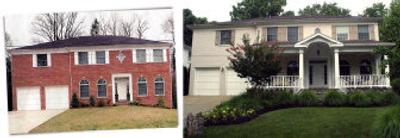
In a neighborhood filled with large but elegantly scaled prewar homes, it stood out for all the wrong reasons. Gracelessly proportioned and stylistically indeterminate, the house, built in the late 1980s, resembled a giant red shoe box. Between a jarring imbalance of windows, a half-hearted attempt at landscaping and fortress-inspired masonry, it had a facade only a mother could love.
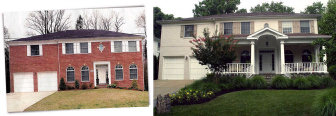
To her credit, Henderson, a single mom raising two boys, had a nurturing instinct. She immediately saw past the house’s flaws to its winning potential, and knew just how to unlock it. A new coat of off-white paint, for starters. And a new porch. A big one.
Transformed by the addition, the house is now unrecognizable as the block’s once-ugly duckling. The porch lends much-needed dimension to the facade’s flat plane, makes organizational sense of the oddly positioned windows and has the overall effect of making the house look several decades older than it actually is, finally integrating it into the community architecturally.
To hear Henderson tell it, her new porch was greeted as if she had mercifully razed the red behemoth and built anew. “People from the neighborhood kept coming up to me and thanking me for doing it,” she says.
Adding a porch to a house in need of one, says Michael Dolan, a Washington resident and author of “The American Porch: An Informal History of an Informal Place” (Lyons Press, 2002, 352 pgs., $24.95), is like “adding the eyebrows and eyelashes to a drawing of a face. It gives it character; it gives it individuality.”
In a frenzied real estate market such as Washington’s, where capital improvements are almost always made with an eye toward increasing resale value, one might think that the decision to add a porch is all about pushing a house up toward that next price point. But that’s not the primary reason cited by people who embark on a porch addition project, says Jim Rill of Rill & Decker Architects in Bethesda, Md.
“They just want their house to be more welcoming,” says Rill, who estimates that his firm has handled at least 50 porch or portico additions over the past 10 years. “And they want to have a place outside the house that’s in-between the exterior and interior.” A porch, he says, “allows people to sit outside with some sense of protection, both physically and mentally, in that you feel like you’re still `in’ your house. Putting a roof over it gives you that sense of privacy. But you can still connect with the streetscape.”
The veranda that Henderson commissioned from designer-builder Anthony Wilder, part of a larger renovation that also included the house’s interior, did not come cheaply. Wilder estimates that the total cost of the porch – which includes a Carderock foundation, a bead-board ceiling, electrical wiring and classical architectural touches – was upwards of $90,000.
Though she could have saved many tens of thousands of dollars by building a portico – essentially a porch-in-miniature with a gable and columns sheltering a doorway – Henderson decided the extra money would be well spent. “Other architects I spoke with suggested adding a portico, but they just weren’t big enough. The house was so flat that we needed to totally redefine the front.”
Both Rill and Wilder place the cost of a large custom porch addition from anywhere between $75,000 to $125,000, a figure that factors in the costs of not only the foundation, architecture, wiring and details but also extra landscaping.
But F. Andrew Boyd of Arlington, Va., doesn’t see why it has to be so expensive. The architect recently completed an 8-by-30-foot porch addition to the red-brick Cape Cod he and his wife bought in 1995. By using standard materials – fiberglass columns, skylights, air-dried and treated lumber planks for the floor – and by taking his own sweet time to put them all together, Boyd says he held costs to about $15,000.
Of course he wasn’t paying architect’s fees, and he performed most of the labor himself. Plus, he readily acknowledges, any paying client would justifiably demand that the project not take the 18 months he took to finish. But Boyd has built similar porches for others – some of whom, he says, have commissioned him on the basis of walking by his house and liking what they’ve seen – and maintains that a quality, if not super-fancy, porch addition can be had for less than $50,000.
His wife, Ann Gorton Boyd, notes that the new porch is “an ideal place to appreciate the changing seasons” and that “it’s our favorite place to just sit and talk with friends.” But in addition to serving as a social space and an ideal vantage point from which to watch the world go by, the addition also “mitigates a design flaw of our Cape Cod-style house: the absence of a foyer or entrance hall,” she says. “The porch provides a much-needed visual and psychological transition between the outside world and our living room.”
Porch historian Dolan agrees that these spaces are about bridging the public and private in a way that ultimately encourages sociability. People who sit on porches, he says, are “making a statement about connecting to their community. A porch bespeaks not only your own place in the world, but also that place from which you reach out to the larger world. It frames the larger world, literally and figuratively, and allows you to present yourself to it for encounters with other people.”
David Griffin and Kathy Moran have had plenty of encounters with other people since Alexandria, Va., architect Charles Moore turned their 660-square-foot Arlington, Va., rambler into a multi-award-winning modern Arts and Crafts bungalow. Very quickly, the house went from nondescript to nonpareil, the sort of place that attracts pilgrims who have seen it celebrated in local magazines. Its public face, once the essence of plainness, now stops passersby in their tracks (or cars) – thanks not only to the smart shed dormer that Moore added to a new second floor, but to the porch, which runs the length of the house.
“When I bought the house, you just stepped off (the stoop) into the yard,” says Griffin. “There wasn’t even any pathway.” With nine feet in which to expand the house outward, Moore and his clients decided to dedicate six of them to a porch that would powerfully broadcast an instant message of warmth and openness.
That message, says Moore, is ultimately “an invitation.” The Arlington zoning guidelines that allowed him to push construction closer to the street “gave the house a special character that other houses with porches, the kinds that are set back from the street, don’t have. All you can do in those houses is wave from your porch,” he says. “From this one you can have an actual conversation.”