
recycling with rik
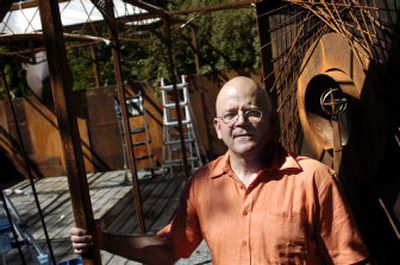
“When my wife Deb and I were courting,” says metal artist Jason Sheldon, “we’d go out on dates to the scrap yard to see who could find the best stuff.”
That’s an unusual date, but Sheldon has a great explanation.
“Scrap yards are full of metal shards, leftovers some fabricator couldn’t reuse. Circles, triangles, all sorts of shapes. Sometimes there’d be 50 identical pieces,” he says. “Junk to the fabricator, but building blocks I could weld into sculpture.”
That transformation takes a vision. The 18th-century painter William Hogarth was inspired by the ideal form of the serpentine line. Proto-cubist painter Paul Cezanne was fascinated by how shapes in nature can be reduced to spheres, cubes, cylinders. For Sheldon, it’s the spiral – how that line manifests three-dimensionally.
Sheldon says, “The spiral is everywhere in nature. Lightning spirals down a tree trunk. A corolla of flower petals spirals out from the center. Even exposed tree roots tend to spiral.”
A braid is a spiral, and for some of his sculptures, Sheldon has braided steel bars, separated them, and reconfigured them, erect, on a steel base. They look like plant shoots twisting out of the earth, spiraling toward the sun. “It’s like drawing in space with steel,” Sheldon says.
Sheldon’s material-of-choice was not always metal. That came about over time. In high school art class, he made ceramics. His first job out of high school as a deckhand on a tugboat introduced him to paint.
“I did a lot of maintenance painting,” Sheldon recalls. He didn’t care for it much. “I was still learning to work. But I got to know the feel of paint and learned to be proficient with cut-in brushes, the more detailed work.”
Later, employed as a plumber’s helper, he learned to solder copper pipe. He says he now sees all these early work experiences preparing him, spiraling him, toward his eventual career as an artist.
Sheldon’s first sculptural work was a walking stick from apple wood from his childhood home.
“I discovered I really liked the finishing work,” he says, “the sanding, smoothing, the way the boiled linseed oil finish brought out the colors and the grain.”
Once Sheldon realized his affinity for wood, he started buying 2x2-inch hardwood blocks and carving them with a rotary tool. Eventually, he progressed to 4-foot high pieces his wife Deb characterizes as “organic abstract.” They appear as choppy waves stacked vertically in space with an internal spiral armature.
When Sheldon had enough work finished, he began showing his art professionally. At a show in Scottsdale, he saw an artist who was overlaying wood with copper. The overlay idea appealed to him and he produced a series of sculptures utilizing the technique.
Gaining confidence with metalsmithing, Sheldon started making copper fountains. Then he experimented with sheet metal, and finding it as malleable as copper and less expensive, worked extensively with it, producing hammered frames for mirrors and artwork.
“Sheet metal doesn’t have to be heated to be bent and shaped,” he says. “And I can paint it, rust it, or color it any way I want.”
Sheldon’s shapes his sheet metal pieces with an air chisel. He’s rounded the chisel point off like a ball-peen hammer and says his customized tool is not only speedier than hammering by hand, but saves his wrists and forearms from the repetitive concussion of hammering.
Another tool he’s “invented” is an old boiler exchanger that’s pointed on one end. He’s given this cast-off a new life as an anvil, using it to dimple metal with a rubber mallet.
Besides bas-relief sheet metal decorative panels, Sheldon creates one-of-a-kind iron and steel arbors, gates, railings, trellises, benches, tutorials and fountains. In these creations he often integrates found objects and other recycled materials.
“People are using outdoor space more and more as living space,” he says. “They want art pieces that can live outside – a wall relief, a garden sculpture, something pleasing to the eye. I think my work pleases them because the spiral form I use so often has a direct connection to nature. Designs based on it provide structure, order, balance – a pleasant moment in life. Beauty.”
Jason Sheldon can be contacted through the Twenty-Ninth Avenue Art Works, 3128 E. 29th, Spokane, 534-7959.