
Tribes clean up Drumheller Springs
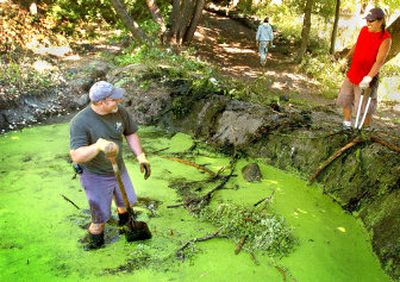

Mark Stanger steadily snipped away at twigs, clearing brush along worn, wooden steps encircled by plants. Around him, teams of people hauled away cut branches. Others, armed with chain saws, trimmed overgrown shrubs and trees, the saws occasionally drowning out the sound of chirping birds.
Stanger was among about 20 volunteers from the Upper Columbia United Tribes who gathered at Drumheller Springs on Wednesday to clean up the park. The five tribes – Coeur d’Alene, Kalispel, Kootenai, Spokane and Colville – permanently adopted the 12-acre park through the city of Spokane’s “adopt a park” program. The park, tucked away in a residential area on the 1700 block of West Euclid Avenue, isn’t well-known, volunteers said.
“I was born and raised in Spokane, but I didn’t even know this park was here,” said Stanger, who works for the Coeur d’Alene Tribe’s fish and wildlife department as an education and outreach specialist.
The park has been “undermanaged” for years, said Mary Verner, City Council member and Upper Columbia United Tribes’ executive director.
“We want to just clean it up, but keep it very natural,” Verner said. “It’s intended to be a wild park.”
Unlike other developed parks, Drumheller Springs is considered conservation land or a natural area that is maintained in its native state. There are no swings or benches or fountains, just trees, wild grass, a pond and a lone trail.
The park cleanup began Wednesday and volunteers expect to return several times.
“We’re always taught to be caretakers of the land,” Stanger said. “Although (the park) is not part of the reservation, it’s part of mother earth … if we don’t take care it, it won’t take care of us.”
The site also has cultural and historical significance, especially for the Spokane Tribe.
“This is one of our known campsites,” said Bryan Flett, of the tribe. “It’s a physical reminder of the stories we were told years ago.”
Drumheller Springs is also the site where Chief Spokane Garry is believed to have created the first school for American Indians in the area in 1830; he taught Protestant religion and agriculture, according to a plaque at the park.
Apart from cutting away the overgrowth, volunteers also started cleaning the pond and pulling out weeds. Eventually, the group wants to replace the wooden steps that weave through one section of the park and clear pathways for easier access. They hope to help restore some of the area’s native species.
The area was rich in camas, bitterroot and other plants that were staples for the tribes, Flett said. In some sections, some camas can still be seen, camouflaged by the long sun-baked grass. In the past, local students planted drought-resistant native flowers and shrubs as part of the Drumheller Springs Wildlife Enhancement Project.
Verner said the cleanup exercises are an opportunity for the younger members of the tribe to learn about the plants and how to take care of them.
Volunteer Rozalyn Sanchez, 15, was weed-whacking and clearing away cut branches. From the Coeur d’Alene Tribe, she works for the Spokane Tribe during the summers, she said
“It really didn’t look that good when we got here,” Sanchez said. “Now we can make it better.”
Ray Entz, from the Kalispel Tribe’s wildlife division, said the five tribes collaborate on many projects and the park cleanup is another opportunity to work together and also give back to the community.
“We’re here to support the Spokane Tribe and their cultural connection,” Entz said. “This is a long-term commitment for all five tribes.”
Other than its overabundance of weeds and overgrown vegetation, the park is fairly clean.
“There’s no trash to speak of,” Entz said. “That way it’s been a blessing.”
Flett said the park’s semiwilderness provides a great escape within easy reach.
“The (city of Spokane) should be proud to say that right in heart of the city, you have a natural park,” Flett said.