
Reebok CEO’s insight paid off
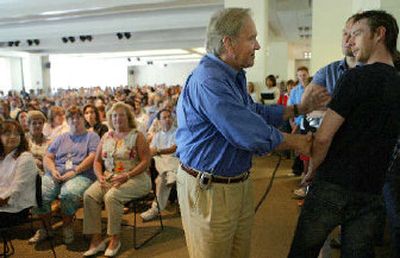

BOSTON — For a quarter-century, Reebok’s top executive and his wife have staked their future on the athletic shoe and apparel maker’s success, and they’ll be rewarded with more than $800 million when they cash out on their shares following the company’s acquisition by Adidas.
The value of the 17 percent stake that Paul and Phyllis Fireman hold in Reebok International Ltd. would rise from $598 million to about $803 million under the pending acquisition by Adidas-Salomon AG, according to an Associated Press analysis based on Reebok’s regulatory filings.
The $205 million increase in the value of the Firemans’ more than 13 million shares is the couple’s windfall from the 34 percent premium Adidas is paying for Reebok’s shares — $59 a share compared to Reebok’s $43.95 closing share price the day before the $3.8 billion cash deal was announced on Wednesday.
Reebok said the Firemans have agreed to vote their 13,615,212 shares in favor of the Adidas deal, which requires shareholder and regulatory approval.
Reebok spokeswoman Denise Kaigler did not return phone messages Thursday seeking comment on the Firemans’ compensation.
Paul Fireman, 61, is unlike executives who have been criticized for leading a company for a relatively short time, selling it off and then cashing in when the company is bought out at a premium.
Reebok was a small British shoe maker when Fireman, formerly in the sporting goods business, spotted some Reeboks at a Chicago trade show in 1979, liked what he saw and bought the U.S. rights for the brand.
When the popularity of aerobics took off in California in the early 1980s, Fireman capitalized on the trend by offering specialized aerobics shoes that became big sellers, laying the foundation for later growth in basketball and other sports and the company’s initial public offering in 1985.
“It was really that insight that propelled the company through a period of very rapid growth,” said John A. Quelch, a Reebok board member for 12 years and now a Harvard Business School professor.
Paul and Phyllis Fireman have snapped up shares of the company along the way, betting on its growth.
Paul Fireman, now the company’s chief executive and chairman, has maintained leadership of Reebok, although he has at times cut back his involvement to focus on non-Reebok projects like golf course development before returning to overseeing Reebok.
Fireman is expected to remain Reebok’s top executive through the Adidas acquisition, which the companies expect to close in the first half of next year.