
U.S. forces storm Iraqi towns

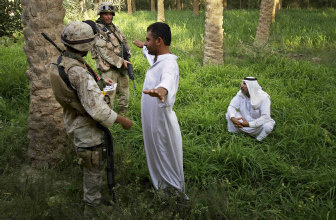
BAGHDAD, Iraq – U.S. and Iraqi forces struck back at insurgents Friday, storming a cluster of northwestern towns in a region where 22 Marines have been killed this week.
The assault near the city of Haditha, in violence-plagued Anbar province, came as politicians seeking to complete a draft of a new Iraqi constitution by Aug. 15 suffered a setback. Leaders of the committee writing the document and top government officials postponed until Sunday a meeting scheduled to work through several remaining sticking points.
The delay came after Massoud Barzani, president of the Kurdistan region of Iraq who is pushing for greater regional autonomy, decided to remain in the Kurdish capital of Irbil to huddle for a day with his parliament before traveling to Baghdad to negotiate.
In Anbar, beginning before 6 a.m., 180 Iraqi soldiers and 900 members of the 2nd Marine Division, backed by M1-A1 Abrams tanks, helicopters and jets bearing 500-pound bombs, stormed into Haditha, Haqlaniyah and other small towns along the Euphrates River where military officials believe insurgents are mustering to launch attacks. Iraqi Special Operations forces helped direct U.S. air strikes Friday morning, according to a military news release.
The province has seen at least a half-dozen similar-size offensives by Marines since early May, most farther west along the Syrian border, where Marines have sought to stem the flow of foreign fighters and weapons into Iraq. But the insurgency has remained strong in the Sunni Arab-dominated region, where opposition to the U.S. presence runs deep.
“When we did operations out west, the insurgents moved to the Haditha-Haqlaniyah area,” said Col. Bob Chase, the operations chief for the 2nd Marine Division. “That area is a geographic crossroads where they can get north to Mosul and east to Ramadi and Baghdad. It has good urban terrain for them to melt into. And we are well aware there are still plenty of ammunition supplies from the Saddam Hussein era for them to make use of.”
The Marines were already positioning for the initial stages of what they have dubbed Operation Quick Strike on Wednesday when 14 were killed as an amphibious assault vehicle struck a roadside bomb near Haditha, a city of about 70,000.
Chase said the roadside bombing, and another attack Monday in which six Marines were killed by small-arms fire, were still under investigation. There is “no evidence whatsoever” that insurgents were tipped off by Iraqi forces in launching the attacks.
Elsewhere in Iraq Friday, much attention focused on efforts to reach a compromise on issues remaining to be settled in the constitution-writing process.
Prime Minister Ibrahim al-Jaafari met with Iraq’s most influential Shiite Muslim cleric, Grand Ayatollah Ali Sistani, in the southern city of Najaf. Al-Jaafari was seeking support for two constitutional provisions still encountering opposition: that Islam is a main source of Iraqi law, and that the country be governed through a federal system in which some power is devolved to regions.
At a news conference after their two-hour meeting, al-Jaafari said Sistani endorsed both views.