
Field Reports
OFF-ROAD VEHICLES
Tread Lightly offers tips for responsible riding
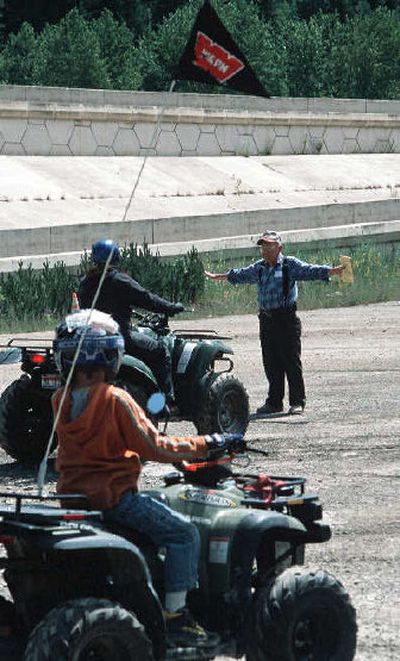
Tread Lightly, a nonprofit organization that educates people to recreate responsibly, has issued some practical tips on minimizing the impact of all-terrain vehicles on the environment:
•Stay on roads, trails or other areas designated for ATV use.
•Try to stay in the middle of the trail to avoid widening it.
•Cross streams only at designated fording points, where the trail crosses the stream. Approach the stream slowly, crossing at a 90-degree angle.
•On switchbacks, avoid roosting around the apex of the turn when climbing or brake-sliding during descent, both of which gouge the trail.
•On slick trails, moderate the throttle and use the clutch to gain maximum traction with minimum wheel-spin.
•Try to avoid muddy trails, save them for future trips when they are dry.
•Pack out what you pack in. Carry a trash bag on your vehicle and pick up litter left by others.
•Following a ride, wash your ATV and support vehicle to avoid spreading noxious weeds the next time you ride.
•Always wear a helmet, eye protection and other safety gear. Take an ATV training course to maximize safety.
Rich Landers
OFF-ROADING
Study concludes economy could survive restrictions
Proposed restrictions on motorized travel in the Gallatin National Forest would likely have few impacts on the local economy, a new federal government study concludes.
The 50-page study by a U.S. Forest Service economist and a social scientist from the agency’s regional office in Missoula looked at potential effects of the agency’s plan to limit vehicle use.
Gallatin National Forest officials earlier this year proposed big cutbacks in motorized travel on the 1.8 million acre forest in southwestern Montana.
The plan calls for cutting the miles of trails open to ATVs from 281 to 166; cutting the miles of motorcycle trails from 457 to 238; and cutting the non-wilderness acres now open to snowmobiles from 84 percent to 65 percent. Forest officials contend the changes are needed to help improve wildlife habitat.
The Forest Service study found that non-motorized forest users actually generate nearly twice as much money to the local economy than vehicle users in the Bozeman region, although that might not be the case in other parts of the country.
Non-motorized recreation produced $7.3 million in economic activity and supported 330 jobs surrounding the Gallatin; while motorized recreation, particularly snowmobiling, created $3.9 million in spending and 185 jobs, the study found.
Staff and wire reports
BIRDWATCHING
Songbird attempts comeback in California
A chatty songbird thought to have disappeared from California’s Central Valley 60 years ago has been spotted nesting in a patch of restored habitat along the San Joaquin River.
The Least Bell’s Vireo, a little gray songbird that fits in a closed fist, was once widespread in the Central Valley. It disappeared from the area as the riparian habitat it favors was ripped up to make way for development and agriculture. About 90 percent of the valley’s historic riverside vegetation has been lost, said Al Donner, spokesman for the U.S. Fish and Wildlife Service.
The bird was put on the federal endangered species list in 1986, when there were only about 300 pairs left in the low-lying shrubbery along creeks and streams in Southern California.
Several birding experts were calling in and a recording was made to confirm the sighting of the nesting pair.
The area where they were found had been a ranch, which was bought in 1998 and restored over the last three years by Fish and Wildlife with help from the state of California.
Associated Press
TOURNAMENT FISHING
Bogus fish stories no longer laughing matter
Tournament fishing is putting the kibosh on a fishing tradition.
With prize money ranging well in to the six digits, telling a lie about the fish you catch isn’t a laughing matter.
Polygraph tests are as much a fixture at open fishing tournaments as crankbaits, coolers and scales. They’re given routinely to tournament winners to prevent and detect cheating.
The threat of a polygraph helps deter contestants from catching lunkers ahead of time, putting them on a stringer and tying them to a stump in the lake.
Joe Gallimore of Sumter, S.C., often is hired to administered a polygraph at regional fishing contests. At one tournament, Gallimore said, “two anglers were surprised I was there, packed up and drove off. They had won second place, $1,200-$1,500.”
“Keeping honest people honest and keeping out the riff-raff,” Gallimore said of the value of a polygraph. “Fishermen know if they get caught cheating their name is mud.”
However, BASS, the nation’s largest fishing organization, has dropped polygraphs now that competitor usually have observers on their boats.
Fishermen support the tests. Pro angler Jason Quinn of Lake Wylie said polygraphs instill confidence in the tournament’s integrity. Anglers “want to make sure everything is fair and square,” said Quinn, who said he’s taken and passed 15-20 tests over the years.
Staff and wire reports
ENDANGERED SPECIES
Aleutian Canada geese status improves in Oregon
Oregon Gov. Ted Kulongoski is expected to sign a bill passed by the Legislature that removes the Aleutian Canada goose, a major pest to farmers, from the state’s threatened species list.
The geese were removed from the federal list in 2001 after it was discovered the population had grown to near 70,000, mostly because of West Coast predator control.
California began permitting limited hunting of the birds earlier. But in Oregon, ranchers couldn’t even legally haze the birds to move them to public land.
The birds prefer commercially grown grass, and they eat a lot of it. Oregon is their last stop before their 3,000-mile flight to their breeding grounds in Alaska’s Aleutian Islands.
The bird is one of seven subspecies of the goose. The bill would allow the Oregon Department of Fish and Wildlife to manage the goose population, possibly including hunting. Even the Audubon Society has advocated the state delisting.
Associated Press