
‘We live in harmony with nature’
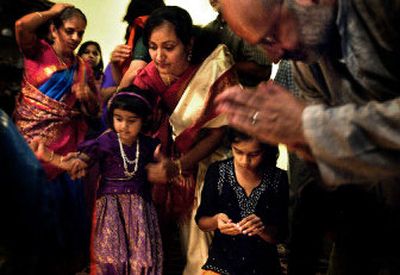

One thousand names exist for the Hindu god Krishna.
Mallur Nandagopal chanted them all Friday evening as he and other followers of Hindu celebrated Janmashthami, the birthday of Lord Krishna.
Reading the names out loud from a prayer book in Sanskrit, Nandagopal was joined by his family and about 60 others who sat on the living room floor as they prayed around a small altar adorned with lights, grapes, peaches and East Indian snacks.
By the end of the worship service known as the puja, the small bronze statues of baby Krishna and Ganesha – the elephant-headed god of luck – were covered with offerings of flowers, fruit, spices, rice and other foods.
“Hinduism is one of the most beautiful religions,” said Nandagopal’s wife, Sreedharani. “It’s a way of living. … We live in harmony with nature so we worship the trees, the rain, the sun, the moon, the mountains – everything we need for our existence.”
Unlike bigger cities with larger Hindu populations, Spokane doesn’t have a temple for formal worship. So the more than 50 Hindu families who live in the area meet once a month in one another’s homes.
Friday night’s party was extra special for the Nandagopals. Two of their three grown daughters were able to come home for Janmashthami, so they invited all their friends – both Hindus and non-Hindus – to celebrate not only Krishna’s birthday, but also Ganesha’s festival, which would normally be observed in early September.
Many of the women arrived wearing colorful saris made of silk and adorned with gold. Some of the men also wore traditional clothing. They took their shoes off as they entered the north Spokane home, carrying bouquets of flowers and vegetarian dishes of rice and Indian delicacies. While many greeted each other in English, some spoke Kannada, Tamil or Hindi.
“This is a way for us to connect with God and to keep our cultural heritage alive,” said Aruna Bhuta, of Spokane.
Devesh Mathur, who moved to the area nine months ago from Albany, N.Y., said the gatherings have helped his family feel more at home here in Spokane. They also provide opportunities for his sons, ages 5 and 1, to learn about India and their faith.
Non-Hindus, including Steve Schneider, an attorney in Spokane, have also started attending the gatherings. “It widens your perspective,” said Schneider, a fan of Indian Bollywood films who started learning Hindi earlier this year. “It gives you a broader view of the world.”
The Nandagopals have gone out of their way to teach people about Hinduism and their native India ever since they moved here nearly 30 years ago. Mallur, an engineer for the city of Spokane’s Water Department, and Sreedharani, who teaches math at Spokane Falls Community College, often invite their non-Hindu friends to worship services followed by vegetarian feasts at their home.
Area colleges, elementary schools, churches and other organizations often ask Sreedharani to come and talk about her faith. “It’s not easy to discuss 5,000 years of culture and history in 50 minutes,” she says.
A tiny woman with piercing green eyes and an infectious laugh, Sreedharani is called “Auntie” by the younger members of the East Indian community and just “Sree” by everyone else. She’s the powerhouse behind many of these pujas and the many cultural events sponsored by the South Asia Cultural Association.
For the last few days, Sreedharani has spent all her free time in the kitchen cooking and baking in preparation for Friday night’s party. One of the dishes she paid careful attention to was the payasam, a dessert made of milk and dal that must be offered at the altar and served to guests during the feast of Janmashthami.
The area’s Hindu community has many celebrations, she said, because they worship so many deities and the various forms of those gods. Krishna, for instance, is the reincarnation of Vishnu, the “preserver” and the second member of the Hindu trinity that includes Brahma and Shiva.
To practice their faith, Hindus observe nonviolence, which includes vegetarianism. They worship in different ways – through meditation, the chanting of mantras or yoga. Often, paying homage to their gods simply means fulfilling their duties – to feed the hungry, take care of their families, make the world a better place.
Their religion embraces both pain and pleasure, explained Sreedharani, because both offer meaning and inevitably are part of life.
It is a faith that’s full of color, tradition and joy, many say.
After the puja Friday night, those gathered at the Nandagopal home stood up, clapped their hands and sang in Sanskrit: “Let everything in the world live happily and be prosperous.”