
Elks’ therapy program at risk
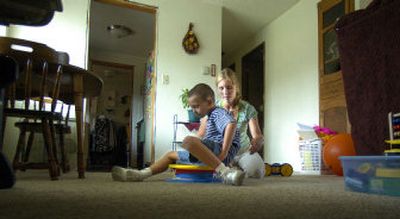
Lila Zander coaxes Caitlin Cunningham to climb into a large, pink body sock, then swings her around. She makes her clap and chase after bubbles, build a tower of colored cups and bounce up and down on a large rubber ball.
What looks like mere play is actually therapy for little Caitlin. In part, the activities help the 3-year-old, who lives in Sprague and has developmental delays, to strengthen her body and develop her balance and sensory systems.
Zander, an occupational therapist, helps children through the Washington Elks Therapy Program. But the free in-home program that has served local families for more than 50 years could be axed due to budgetary woes and changing priorities, organizers say.
Elks lodge representatives will vote in January whether to keep the program or redirect the money to another venture, said George Prichard, the program’s secretary/manager. It costs $1.4 million a year to run the operation; some of the money comes from membership fees and the rest from organization trust funds. However, state membership in the fraternal organization has decreased from 100,000 in the 1970s to a little over 33,000 today, Prichard said.
“It just seems to be no end to this,” he said, adding that membership numbers keep diminishing by 4 percent to 5 percent annually and so far efforts to recruit more members have been unsuccessful.
Coupled with low numbers is some members’ belief that the organization’s money could be invested better elsewhere, Prichard said.
Members have proposed funding a children’s hospital as an alternative, Prichard said. He said some have questioned the efficiency of having mobile therapists instead of a central location.
Both Zander and Prichard said the program’s closure will especially hurt families in rural areas with limited access to services.
“There is a tremendous need for the therapist to go into the home because of extenuating circumstances,” Prichard said, noting that many of the families would have to travel great distances for other services. “We are a vital part of the services offered out there.”
The statewide program’s 14 therapists have an average of about 20 children in their caseloads. Zander serves Lincoln, Spokane, Stevens, Pend Oreille and Ferry counties and works with 27 children. “Eighteen of these kids I know for a fact would never receive any other services,” she said. “You know you’re helping people that otherwise wouldn’t get help.”
Children can qualify from birth to the age of 21 for Elks therapy, and it is the only free, in-home therapy program in the area for children older than 3, Zander said.
Zander’s office is her car, or the “Elk Mobile” as she calls it. She spends about 20 hours a week on the road traveling from one town to another. For many of the families she visits weekly, commuting to Spokane on a regular basis for therapy sessions is not a viable option.
“I am the only resource for these parents,” Zander said. “And that’s big if you’re living out in the middle of nowhere.”
Erin Gollehon, who lives in Wilbur, said she would have to drive an hour and a half each way to get services in Spokane for her daughter Allison. The 4-year-old, who has received Elks therapy since she was 8 weeks old, has Down syndrome.
“You don’t know that your child is going to have special needs,” Gollehon said. “You prepare for a healthy child … emotionally, the support is so needed.”
She said Zander and another Elks therapist have helped with everything from improving the baby’s muscle tone to daily tasks such as eating and putting on her socks.
“It’s just so imperative that these little children are able to have this because that’s when they learn the most,” she said. “I don’t know what I’ll do if they take this program away.”
Kelly Anderson, a Northeast Tri-County Health District public health nurse who serves Stevens County, said she has referred several families to the Elks program, particularly those in remote areas.
“The program has been a godsend,” she said. “I would have kids who wouldn’t receive services until they went to school.”
Therapy sessions in school can be as little as 10 minutes a week, Anderson said, while Elks therapists visit for a whole hour in the home.”The Elks therapist is not only beneficial for providing therapy for children but also education for the parent to continue when she’s not there,” Anderson said.
For other families it’s not just accessibility that makes them turn to the Elks program but also the inability to qualify for other programs. Zander has been seeing 7-year-old Kade Yerxa in Spokane since May. His mother, Rachelle Yerxa, said the autistic boy is ineligible for Medicaid, and the family’s health insurance stopped paying for his therapy sessions once he turned 7.
At a therapy session recently, Zander made Kade spin on a wheel, twist his way through a bright orange cloth tunnel and put some pieces on a puzzle to help improve his motor skills and attention span.
“Sitting down takes a lot of effort for these kids to actually focus on one activity,” Zander said. “The other day he strung beads for me – I was so excited.”
Zander and Prichard said those suggesting that the program be cut may not be aware of its impact. Zander said she plans to visit Elks meetings in the coming months to create awareness.
“I’m fighting for the kids. It’s the kids in these rural areas that are going to be lacking,” she said.