
Former senator known for anti-war stance dies
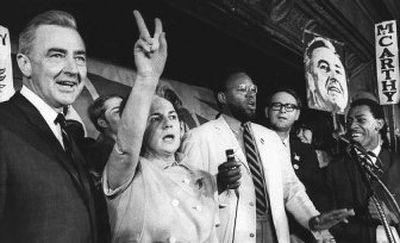
Former U.S. Sen. Eugene J. McCarthy, D-Minn., whose surprisingly strong showing in the 1968 New Hampshire presidential primary dramatized deep- ening public opposition to the Vietnam War and effectively ended President Lyndon B. Johnson’s political career, died Saturday. He was 89.
McCarthy died at a retirement home in the Georgetown section of Washington, D.C., where he had lived for several years.
A relatively obscure senator who turned sour on the war as the United States escalated its troop buildup in the mid-1960s, McCarthy entered the New Hampshire primary partly to fill a vacuum: More-prominent anti-war politicians, assuming that Johnson was unbeatable, had decided not to run against him.
McCarthy’s candidacy initially was dismissed as hopelessly quixotic. Historian Doris Kearns Goodwin, in a biography of Johnson, wrote that the challenge “was regarded by official Washington as a somewhat baffling exercise begun by a hitherto stable member of the Senate liberal establishment.”
But McCarthy’s campaign caught fire with young people – the vanguard of opposition to the Vietnam War – and hordes of them traveled to New Hampshire to help his cause. They stuffed envelopes and passed out leaflets in what became dubbed “the children’s crusade.” Many cut their long hair and put on fresh clothes to help impress older voters. Be “Clean for Gene,” their watchwords urged.
Johnson had not declared his candidacy formally yet, so his name was not on the primary ballot. But it was assumed he would seek re-election, and New Hampshire Democratic leaders organized a write-in campaign for him, fully expecting a win.
Johnson did win – but not easily. He garnered 49 percent of the vote; McCarthy, 42 percent. The results shocked analysts, showed that LBJ was vulnerable, and jolted other politicians into action.
Four days later, Sen. Robert F. Kennedy, D-N.Y., who earlier had decided against seeking the nomination, reversed himself and jumped into the race. Two weeks after that, Johnson stunned the nation by announcing he would not seek a second term.
McCarthy’s glory was short-lived. Kennedy captured much of the momentum that had been propelling the McCarthy campaign, and the laconic Minnesotan proved unable to expand his base of support sufficiently. Some people placed part of the blame on his diffident campaign style. His friend, the poet Robert Lowell, said of McCarthy, “The last thing he wanted to do was to be charismatic. He was a mixture of proud contempt and modest distaste. … Usually the cheers were greater when he came in than when he finished speaking.”
Kennedy scored a major triumph when he won the California primary in early June, but that night he was fatally wounded at a Los Angeles hotel after delivering his victory speech. Vice President Hubert H. Humphrey – a fellow Minnesotan who had served in the Senate with McCarthy – went on to claim the Democratic nomination. Humphrey, in turn, narrowly lost the November election to Republican Richard M. Nixon.
Truculent as well as contrarian, McCarthy abruptly decided not to seek re-election to the Senate in 1970, disappointing many supporters who hoped he would use his office to continue to push for an end to U.S. involvement in Vietnam. Ironically, Humphrey re-entered the Senate by winning the election to succeed McCarthy.
McCarthy ran for president several more times but never came close to recapturing the constituency he had forged in New Hampshire.
Historians have come to regard his 1968 candidacy as a turning point: a campaign that galvanized Americans’ previously fractured opposition to the war and pushed successive administrations into desperately trying to extricate U.S. forces from Southeast Asia. It also stands as one of the most vivid examples of successful grass-roots activism in U.S. politics.
Additionally, it helped spark an overhaul of the political process, particularly within McCarthy’s own party. After anti-war demonstrations disrupted the 1968 Democratic National Convention, damaging the party politically, Democratic leaders revamped party rules to pare the power of political professionals in deciding on candidates and platforms. These changes weakened much of the party’s structure, making it more responsive to insurgents.
Marshall Wittmann, a political analyst at the conservative Heritage Foundation in Washington, D.C. – who as a high school student in Waco, Texas, in 1968 was a McCarthy campaign worker – said the senator’s revolt marked the beginning of the breakup of the old Franklin D. Roosevelt coalition that had fueled the Democratic Party since the early 1930s.
“It opened the way for major changes in the party that pushed it toward the left and enabled Republicans to capture the White House through most of the next several elections,” Wittmann said.
Slow to forgive, McCarthy never overcame his bitterness toward Kennedy, who he believed had exploited the New Hampshire results for his own personal political gain, detracting from the broader anti-war campaign.
“Once Bobby came (into the race),” McCarthy said later, “we weren’t able to run the kind of campaign we wanted to, which was to focus on the issue of the war.”
Much of McCarthy’s last two decades was spent in rural Woodville, Va., about 70 miles west of Washington, D.C. He bought a rebuilt 18th-century stone-and-clapboard farmhouse, where he would entertain the occasional out-of-town visitor in a pine-paneled, book-laden library. He also maintained a modest apartment in Washington.
McCarthy was born in tiny Watkins, Minn., on March 29, 1916, the son of Irish immigrants and the third of four children. He finished high school at 16. At 19, he graduated cum laude with a major in English from St. John’s University in Collegeville, Minn., a school run by Benedictine monks.
He took a job as principal of a country school at Tintah, Minn., and later taught English at a public high school in Mandan, N.D.
In the World War II draft he was classified 4-F because of an acute foot ailment. In 1944, he took a job in Washington, D.C., with the Army Signal Corps deciphering Japanese codes. After the war, he returned to Minnesota, got married and taught economics and sociology at the College of St. Thomas in St. Paul.
While on the St. Thomas faculty, McCarthy became involved in politics and helped Humphrey and other young Minnesota liberals purge the Democratic-Farmer-Labor Party of communist influences. With the party’s backing, he was elected to the House in 1948, where he remained until his election to the Senate in 1958.
McCarthy’s wife, Abigail, from whom he was separated, died in 2001, and a daughter, Mary, died in 1990. He is survived by a son, Michael; two daughters, Ellen and Margaret; and several grandchildren.