
Human rights center opens doors
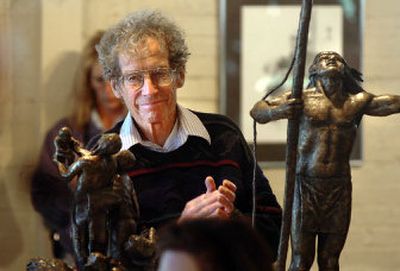
Almost 25 years ago, 10 white supremacists stood behind Tony Stewart as he and others met in a church basement to discuss racist graffiti on a Hayden man’s restaurant.
The neo-Nazis were there to intimidate the small group of eight to 10 people who would later go on to become the Kootenai County Task Force on Human Relations.
But this Saturday, surrounded by more than 100 supporters in a building with the smell of fresh paint on the walls, Stewart watched as the new Human Rights Education Institute opened.
He and other human rights advocates reminisced about how far human rights had come in Idaho, from that small church basement in 1981 to a courtroom victory in 2000 that bankrupted the Aryan Nations into leaving Idaho.
“It’s a glorious moment,” said Norman Gissel, a lawyer in the court case that saw a jury return a $6.3 million judgment against the Aryan Nations and its founder, Richard Butler, after security guards from the white supremacist compound assaulted passers-by in 1998.
“In the whole, when the end of the Nazis was clear, it was the end of a chapter of a book about civil rights that was still being written,” Gissel said. “This is an edifice to commemorate all those years of struggle. We wanted a marker to recognize the end, and we’ll continue to strive for the fullness of democracy.”
Some spent the event looking toward the future of human rights in the state.
“The work will never end,” Stewart said. “There’s always going to be hate and prejudice that must be fought.”
For that reason and others, architectural plans were unveiled for the Human Rights Education Institute, which will be built next to and include the old Battery Building at the edge of Coeur d’Alene’s City Park. The building will house exhibits and serve as a center for human rights education in the Northwest, said Jerry Gee, president of the institute.
A tall gateway with an arch welded by North Idaho College students frames a courtyard to the center, and officials unveiled an 11-foot-tall granite monolith with the United Nations Universal Declaration of Human Rights inscribed on the front.
The monument was donated by human rights benefactor Greg Carr in 2000 and was waiting for a permanent location.
The institute will be built in the next few years next to the city park and will feature meeting areas and exhibit rooms with the goal to educate, Gee said.
The Centennial Trail will run next to the building, and large windows will provide views of the park and Lake Coeur d’Alene.
Renovations to the Battery Building, which stored batteries for the train traveling between Spokane and Mullan, took place throughout the summer.
The remodeled building will serve as the home to the institute while the rest of the complex is built in the next few years.
Saturday’s ceremony featured speeches from local human rights leaders.
Artwork representing each of the 30 articles in the Declaration of Human Rights was displayed on walls, and conceptual designs for a logo for the institute designed by NIC students were shown.