
Treasure Islands
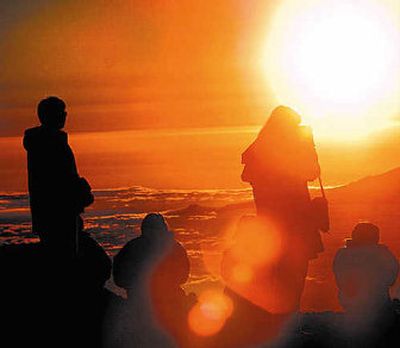

No matter how many times we come to Hawaii, its magic spins a web that makes us want to linger.
Who wouldn’t yearn to stay a little longer where stars spill from the skies, whales come to winter and petroglyphs share the secrets of the islands’ past? It’s enough to make even the most jaded traveler regain a sense of wonder.
There are the smiles, the upward lilt of island voices, the sheer beauty of nature and the compelling stories of its traditions.
Where else could one view mysterious, majestic manta rays as they gracefully glide by in the night to feast on plankton just offshore? Discover a monk seal sunning on the beach? Or a welcoming committee of goats grazing on the tee box of a golf course?
Only here would we choose to play a round simply because we can’t get enough of the peacocks, hens and their babies, wild turkeys and abundance of island birds that will parade by us – even if they do make it hard to keep one’s eye on the ball.
Not yet as densely populated as Oahu and Maui, the Big Island of Hawaii and Kauai call us back most often.
On the Big Island’s Mauna Kea, the clarity of the mountaintop’s atmosphere makes it an ideal site for astronomical observatories. Yet far below we find ourselves gaping in awe at a black velvet sky strewn with more stars than we can begin to name. Islanders have given nature an added boost by installing amber streetlights and black screens.
Ancient trails trace the 20-mile shoreline along the island’s Kohala Coast, where one can easily explore some of the petroglyphs displayed behind the Kings’ Shops and along the Waikoloa Beach Golf Course.
Guests who get away from it all in the grass-thatched cottages at Kona Village enjoy the lava carvings displayed on the grounds of the historic fishing village that houses the resort.
We found the Puako Petroglyph Preserve, with its 9,000 images, most impressive. Unlike our first visit, when we hiked there on our own in the heat of the day, we set out this time on a complimentary tour early one morning with a native-born guide from the Fairmont Orchid at the Mauna Lani Resort.
During a long hike that began along coral sand beaches, we learned that the difficulty varies with the season, as the high surf of the winter months pushes coral onto the beaches, forcing visitors to make their way along black lava and coral-strewn pathways. By the end of the year, the trail is again an easy walk.
In the process of converting the lava fields to resorts, many petroglyph-carved rocks were found, carefully set aside and preserved in the area we’re now exploring. Happily, builders have become increasingly “green” in their recognition of the need to respect and preserve both nature and culture.
A petroglyph of a man holding a paddle overhead tells us of the first settlers’ only transportation. Figures with fuller hips and narrower shoulders belong to women. A stickman with three marks above his head, a cloak suspended from his shoulders, reveals that, in the pecking order of the day, he was the ruling chief. And the turtle, or honu, pictured in rock carvings was considered a family guardian by early Hawaiians.
As we hike, our guide reminds us of Hawaii’s roots, describing how man got here in the first place.
When the ancient Tahitians who discovered and settled the islands studied the stars by which they navigated their large canoes, they also noted the habits of a white bird called the Golden Plover. Much like the whales, it migrated to Tahiti each November, but departed again every May.
Observing this, the Tahitians reasoned that, since these “snowbird” visitors were not equipped with the webbed feet that would allow them to rest on ocean waters, they had to have found a place to make landfall somewhere along the way to a distant summer home.
Packing their 60-foot canoes with three months of provisions, the Tahitians set out on their own 3,000-mile journey. They brought only pigs, chickens and dogs; cattle, goats, donkeys and horses came later.
It is thought the first settlers to the Big Island arrived in winter, in time to view the snow-covered mountain dome they named Mauna Kea, or White Mountain. When Laurance S. Rockefeller, working with local government, chose the lava fields of the Kohala coast – with its perfect white sand beach and year-round sunny weather – as the ideal site for the area’s first luxury vacation destination, this was the name he chose as well.
The Mauna Kea resort was dedicated with a traditional Hawaiian blessing ceremony and, on its 40th anniversary, remains an oasis of quiet, understated Hawaiian elegance. A self-guided tour through the hotel and grounds offers the chance to view one of the island’s most extensive collections of Pacific and Asian art.
Even the golf course created there by Robert Trent Jones was designed with an eye to preserving nature. After first crushing the barren lava rock into soil, Jones maintained the integrity of the coastal site, using such native vegetation as fountain grass and wild ilima to landscape it.
Golf Course Superintendent Milton Nakagawa says such indigenous plantings attract birds. The Mauna Kea and Hapuna courses’ environmentally friendly maintenance is evidenced by membership in the Audubon Sanctuary Program.
To get up close and personal with the farm-fresh ingredients on the Big Island, there is Merriman’s Farm Visits and Dinner. You can experience the complete process of producing the island’s famous coffee, learn about growing gourmet mushrooms and visit a family farm that features organic vegetables, Waimea lavender and freshly cut flowers.
The climax is a four-course dinner prepared by Chef Peter Merriman using this premier produce in his signature Hawaiian regional cuisine dishes.
On Kauai, there are the courting dances of the laysan albatross to entertain us as we stroll along the north shore, tropical fish to make us “ooh and ah” as we snorkel at Ke’e Beach and the joy of coming upon a Green Turtle or a tide pool full of creatures as we’re out for a beach walk.
Visitors can trace the path of the elders at the north end of Kauai as well. One of the earliest settlements in the islands took place in about 200-300 A.D., according to archeological evidence, at the site of Limahuli Gardens at Haena. Although the Polynesians found very few edible native plants upon their arrival, they are believed to have brought about two dozen species with them to propagate for food, such as the breadfruit tree we pass upon entering the gardens.
A row of Pandanus trees on the hill below us curve as gracefully as hula dancers. Their durable leaves have long been woven into everything from mats and baskets to flooring and canoe sails. The discovery of a fossilized specimen that predates human presence on the islands by millions of years finally proved this to be a truly native, rather than introduced, species.
About 700 years old, Limahuli’s ancient rock terraces formed part of the agricultural system that ancient Hawaiians developed to grow their staple food of taro. Many native plants were lost, however, when the valley was used to graze cattle from the late 19th to the mid-20th century.
This makes the conservation and propagation programs carried on at this and other sites of the National Tropical Botanical Garden particularly significant. On Kauai, you’ll find two others, the McBryde and Allerton Gardens, located at the southern tip of the island, across the road from Spouting Horn blowhole in Poipu.
We gave ourselves the bargain treat of a meal at some of the islands’ finest restaurants by visiting them for lunch instead of dinner.
Daylight made it possible for us to catch the surfers in action in the waters at The Prince Hotel in Princeville on Kauai. We also enjoyed eating poolside at the Kauai Marriott Resort and Beach Club in Lihue. On the Big Island, oceanfront lunches at the Mauna Lani or Mauna Kea resorts are among our favorites on the Kohala Coast.
If you visit any of the four main islands between the winter months and mid-April, be sure to include at least one whale-watching trip. About 5,000 humpback whales migrate to Hawaii each year and, despite the fact that you may well see them spouting and breeching from a beach or balcony, there’s nothing like the excitement of following a pod and getting a front-row seat at their marine show.
For even more dramatic and primordial theater, delve into the inner workings of the Big Island’s Kilauea Volcano. Here one can safely view the forces that continue to create the Hawaiian Islands and learn about their unique ecosystems.
You’re sure to run out of time before you’ve run out of wonders to explore. But there’s always the wish list for next time.
Who can resist the call of an earthly paradise where one can slumber beneath a shower of stars?