
Heating bill help wanted

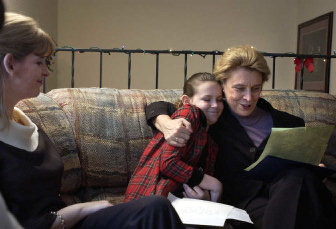
Last year, Pamela Roberts got her family through the winter with the help of a $350 heating assistance grant. It’s a lot colder this winter.
“Without heating assistance, there’s absolutely no way I’d be able to heat this home,” said Roberts, a single mother of two who has been unable to earn a living for her family since she was disabled in an auto accident four years ago.
On Tuesday, Roberts and her children, Tyler, 12, and Megan, 8, were visited by Gov. Christine Gregoire, who announced a plan to help families like Roberts’ while moving the state toward energy independence through promoting biofuels and energy conservation.
“This is an energy agenda that demonstrates our compassion for fellow Washingtonians, providing assistance to those who need it most – low-income families, schools, rural communities and small business – but also reducing our dependence,” Gregoire said.
But the question remains: Will help come fast enough to get energy assistance to those who need it now?
The National Energy Assistance Directors’ Association estimates that only about 15 percent of Americans eligible for federal heating assistance get the help they need.
“There are a lot of families out there that won’t qualify,” said Roberts, who has made a Dec. 30 appointment to apply for energy assistance through Spokane Neighborhood Action Programs.
According to SNAP’s executive director, Larry Stuckart, Congress has earmarked the same amount of funding for the Low Income Home Energy Assistance Program as last year – just over $2 billion – even as the cost of heating has risen.
The U.S. Department of Energy predicts natural gas prices will be 44 percent higher this winter than last as energy prices overall continue to rise, increasing the need for federal heating assistance.
Avista Utilities has increased its natural gas rates by 24 percent and has requested a 9 percent increase in electric rates for residential customers.
In anticipation of federal cuts in heating assistance this year, the state contracted with SNAP to provide about $2.6 million in federal funds to low-income ratepayers, 70 percent of last year’s funding, Stuckart said.
SNAP expects to assist 8,220 low-income households in Spokane County this winter compared with 10,313 households last year.
In Spokane County, about 30 percent of those who are eligible receive assistance, Stuckart said. To date, the county’s largest private human services agency has helped 2,547 households, 700 more than at this time last year.
“At current spending, funding will be gone by Feb. 1,” he said.
On Tuesday, Gregoire said she would ask the Legislature in the first week of its January session to spend an additional $7.6 million on low-income heating assistance for the state. That money would come from the penalty the Washington Utilities and Transportation Commission assessed against the telecommunications company Qwest earlier this year for violation of interconnection agreements.
She also proposed legislation to increase by $6 million the cap on tax credits public utilities get for providing subsidies to low-income ratepayers. The state matches what private utilities pay for such assistance. The current cap is $2.5 million in tax credits.
“These measures will complement what we are doing to assist our customers and provide tremendous benefit to our community,” said Scott Morris, president of Avista Utilities.
Avista assists low-income ratepayers in a number of ways, including participation in the Low Income Rate Assistance Program, which provides about $3 million a year in energy assistance.
The governor’s proposal includes a plan to help make the homes of some low-income families more energy efficient by providing a one-time increase in the Energy Matchmaker grant program.
“We know that energy prices are escalating drastically, and people need help,” Gregoire said. “This is the right thing for Washington to do.”
While agreeing with the general direction the governor is headed with her energy policy, state Republicans took issue on Tuesday with her timing. GOP lawmakers said they tried unsuccessfully to convince Gregoire to call a special session to address the burden of rising heating bills on low-income ratepayers.
“Waiting until session to approve money to help low-income residents with their heating bills this winter is like waiting until the snow melts to shovel your driveway,” state Sen. Jim Honeyford, R-Sunnyside, said in a written response to Gregoire’s announcement.
Honeyford plans to introduce legislation in the upcoming session to capture “windfall” public utility taxes generated by rising fuel prices and using those funds to help low-income ratepayers and invest in renewable energy.
In addition, he said, the money from the Qwest settlement is not a sure thing since the company has recently filed suit against the state for refund of property taxes that may amount to as much as five times the WUTC settlement.
Meanwhile, low-income households struggling to buy food or medicine will be faced with high utility bills costs during a long stretch of unusually low temperatures.
“These people are paying these bills now,” Honeyford said. “They are going to have to make the tough choices in December and January.”