
Deputies cleared in fatal shooting
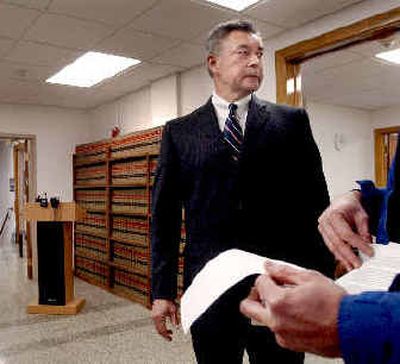
COEUR d’ALENE – The Kootenai County prosecutor cleared two deputies Monday in connection with a Dec. 28 shootout that killed the suspect and seriously wounded a Coeur d’Alene police officer.
Prosecutor Bill Douglas found no criminal fault with the actions of deputies Justin Bangs and Kevin Smart, who fired a combined 31 times in response to the two shots fired by 39-year-old suspect Michael Madonna. Investigators believe it was one of Madonna’s shots that hit Officer Michael Kralicek in the right cheek and lodged in his neck.
“It was justifiable homicide,” Douglas said. “The officers acted properly and lawfully prior to the shooting. Madonna fired first. The officers returned fire to save their own lives.”
Bangs told investigators that he knew Madonna had managed to slip his cuffed hands from behind him to in front of him during a Dec. 17 DUI arrest. In that incident, Madonna also tried to choke a Coeur d’Alene police officer and grab his gun, according to court records.
Yet, 11 days later, Bangs handcuffed Madonna, placed him in a chair and walked away to go talk with Deputy Smart, Douglas said.
“When Bangs returned to Madonna, he had moved his handcuffed hands to the front of his body,” Douglas said. “Bangs warned Madonna that this maneuver had gotten him in trouble during a prior arrest.
“Bangs then handcuffed Madonna’s hands behind his back a second time while questioning him,” Douglas said.
Kralicek arrived at the house just after midnight to investigate the earlier theft of beer kegs from a Lake City distributor. As Kralicek walked up, Bangs again left Madonna alone in the chair, Douglas said.
“Madonna was successful in maneuvering his cuffed hands to the front of his body a second time and he ran through the garage to the house interior door,” Douglas wrote.
As Madonna bolted, Bangs and Kralicek chased him through the attached garage to the door leading into the house. Bangs grabbed Madonna, but lost his grip when he tripped on the stairs leading into the home. Madonna reached inside and grabbed a loaded .357 Magnum revolver from a coffee table. He wheeled and fired twice, Douglas said.
“Bangs probably would have taken that round had he not stumbled,” Douglas said. “It’s very possible that (Kralicek) took the round intended for Bangs.”
Kralicek never unholstered his Glock .40-caliber, department-issued pistol. He had taken out his Taser, but didn’t use it.
“He didn’t have a chance,” Douglas said. “He walked right into hostile fire.”
Bangs told investigators that Madonna fired from around an interior wall. Bangs fired several shots from his .45-caliber pistol through that wall to “suppress” any more shots from Madonna. “And it was successful,” Douglas said, in that Madonna didn’t fire again.
During the first shots, Deputy Smart took cover behind a parked car. He too fired several shots through house walls, Douglas said. One of those rounds killed a blind dog that was inside the home.
Eventually, Madonna again showed himself and said “I’m going to kill you,” Douglas said. Smart fired four times, hitting Madonna in the face, chest and arm.
Sheriff’s Lt. Kim Edmonson said Bangs didn’t violate any department policies when he twice walked away from Madonna and allowed him to move his cuffed hands to the front of his body.
“Deputy Bangs only left to go a few feet away,” Edmonson said. “Madonna took the slight opportunity to bolt.”
Asked why Bangs didn’t take more precautions, Edmonson said Madonna was compliant and was answering questions.
“Officers are trained that if suspects are slipping their cuffs to slip the cuff through a loop in the pants,” she said. “Bangs considered that but Madonna was wearing sweat pants.”
Bangs told Idaho State Police detectives that he and Smart had separated Madonna and his female friend so they could be questioned without hearing each other’s answers, Edmonson said.
Asked why Bangs didn’t put Madonna in the patrol car after he slipped the cuffs the first time, Edmonson said she “can’t second-guess the reasons for that.” That question is not addressed in the investigative report, which is more than 200 pages long.
Ballistics tests show that Bangs fired 17 times and Smart fired 14 bullets. Investigators recovered 20 bullets and nine bullet fragments. Two bullets that exited the house, and two that were imbedded in the house were unrecoverable, Douglas said. Two bullets were recovered from Madonna’s body and one remains lodged in Kralicek’s neck, near his spine.
Only one of the two bullets fired by Madonna was located. It was lodged in a punching bag inside the garage. Forensics experts X-rayed Kralicek in an effort to determine the caliber of the bullet in his neck. However, those tests were inconclusive, Douglas said.
The location of Kralicek’s wound and statements by Smart and Bangs “are consistent with Officer Kralicek being struck by Madonna” and not by friendly fire, he said.
Don Jiran, a retired police lieutenant from Coeur d’Alene, spoke Monday for the Kralicek family. Kralicek remains at Kootenai Medical Center and has recently been fitted with a halo to help stabilize his neck. He continues to improve and has been able to move his fingers and toes, Jiran said.
The family doesn’t blame Bangs for allowing Madonna to make his dash, he said.
Bangs “probably thought that he was sufficiently contained. I don’t find fault in what Deputy Bangs did,” Jiran said. “The family has no animosity toward anybody. It was a tragic event with fatal results.”
Minutes after the shooting, according to the investigative report, Bangs stood with Coeur d’Alene officers Tim Neal and Eric Paul. The 26-year-old deputy was upset and wanted to call his wife, as he told the officers how Madonna fired the shots at him.
According to Paul, Bangs said: “I had him in handcuffs. This is my fault …”
Bangs made no mention of those comments during his Dec. 28 interview with detectives. Idaho State Police detective Curt Kastens reinterviewed Bangs on Jan. 14 about what he said to Paul and Neal just after the shooting.
“I had Deputy Bangs explain to me what he meant, if he said, ‘This is my fault,’ ” Kastens wrote. “Deputy Bangs did not remember saying that, but Deputy Bangs said he remembered ‘Feeling that.’
“He went on to explain that (Bangs) felt, if he could have drawn his gun and shot faster, Officer Kralicek would not have gotten hurt.”
Bangs also told Kastens that he went to Kralicek’s hospital room early on the morning of the shooting.
“Deputy Bangs could recall telling Officer Kralicek and others in the room that he was sorry for everything that had happened and for Officer Kralicek to pull through,” Kastens wrote in his report. “No one in the room asked Deputy Bangs about the incident.”