
Election challenge will go to trial
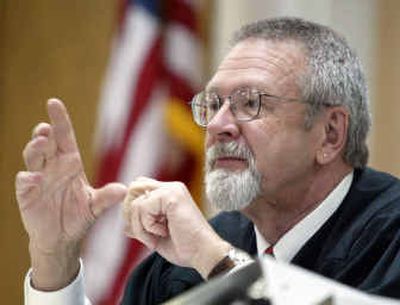

WENATCHEE – The Republican Party’s challenge to Christine Gregoire’s election as governor will go to trial, but the do-over election the party and its standard bearer Dino Rossi want is not an option, a judge ruled Friday.
Chelan County Superior Court Judge John Bridges refused to dismiss the case, as state Democrats had urged. He did narrow the scope of the future trial and set a high standard for allegations of illegal voting and misconduct by elections officials.
“The facts alleged, if proven, are sufficient to prove a prima-facie case” for a contested election, Bridges said. “This case should go forward – at least at this point.”
But if they can prove those facts, a special election for governor “is not permitted by the Washington state Constitution,” Bridges said. “The court doesn’t have that authority.”
Any outcome of the trial is sure to be appealed to the state Supreme Court, as is any remedy Bridges orders after hearing the facts. But after the daylong session in the Chelan County Auditorium, both Democrats and Republicans were claiming victory from the judge’s ruling.
Democrats said the ruling meant the Republicans could, at best, win something Rossi has said he doesn’t want – to be declared the governor by a court ruling. Under some election statutes Democrats cited during the hearing, if enough illegal votes are proved to change the outcome, the new winner after results are reconciled is declared elected.
Rossi was not present at the hearing, but said as recently as Thursday during an interview with The Spokesman-Review editorial board that he believed the only way to ensure public confidence in the person who holds the governor’s office was to have a revote.
“I do not believe you have to do that,” Harry Korrell, lead attorney for the state Republican Party, said of the contention that Rossi would be automatically named governor. Instead, a judge could simply declare a vacancy in the governor’s office, which under state law would be filled temporarily by Lt. Gov. Brad Owen until a statewide election could be held this November.
But Democrats argued during the day’s hearings that under the constitution, a governor can only be elected in an even-numbered year, when legislators throughout the state are also on the ballot. The next such election is 2006.
Bridges didn’t specify which laws would be the controlling factor, if the lawsuit gets to that point. He made it clear that there were many issues still to be argued in the weeks ahead, and that he’ll be merely the first judge to rule on them.
“You can have your plate full when you get to the Supreme Court,” he told attorneys at one point.
The lawsuit is the latest legal battle over the closest statewide election in Washington history. Rossi was narrowly ahead on the first count of ballots, and his margin was further trimmed in a machine recount of some 2.9 million votes. In a hand recount, Gregoire pulled ahead by 129 votes. She was certified as the winner by the Legislature on Jan. 10, but even before that happened the state GOP filed a contest to her election.
Republicans contend the election is invalid because they found evidence that felons who have not had their voting rights restored had cast ballots; that ballots had been cast for voters who died before the election but weren’t removed from the voting rolls; that some people who weren’t Washington residents voted; that others voted twice; and that hundreds of provisional ballots were fed into voting machines before signatures were checked to see if the person was registered to vote.
Democrats have countered that many allegations are minor inconsistencies and discrepancies in record keeping. The GOP has failed to provide the names of anyone it can prove voted illegally, attorneys for Democrats said.
“There’s a drastic, if not staggering, impact of overturning an election,” Kevin Hamilton, an attorney for the Democrats, said.
Bridges agreed an election should not be overturned lightly, adding that that’s why a trial was necessary to hear the evidence.
Early in the day, the judge refused a request to move the case elsewhere, rejecting Democrats’ argument that the dispute should either go to the Legislature or straight to the state Supreme Court.
He said Democrats were wrong, and Republicans right, in interpreting a key sentence in the state constitution that governs how elections are challenged. A court, not the Legislature, is the right place for this dispute, he said. The sentence, which says contested elections for governor and other state executives “shall be decided by the legislature, in matter determined by law,” doesn’t mean the dispute must go back to the Legislature, according to Bridges.
The Legislature has set up laws to handle contested elections, and those laws delegate the authority to the courts.
Any superior court, appellate court or the state Supreme Court could hear the case, he said. The case was properly filed in Chelan County because that county’s auditor – as well as the auditors of the 38 other counties – is named as a defendant.
Although some defendants have complained Wenatchee is inconvenient for witnesses and attorneys, “there’s no evidence that a transfer (to another county) would satisfy the convenience of the witnesses or satisfy the ends of justice,” Bridges said. And he doesn’t have the authority to transfer the case to the Supreme Court.
Much of the day was spent arguing over the meaning of specific sentences, or even parts of sentences, in a series of laws that govern how and why elections can be contested.
On many of these points, Republicans won, staving off at least for now an outright dismissal of their challenges.
The party hasn’t yet proved the allegations, Bridges said, but at this point in the case it doesn’t have to. If felons voted, or if some voters cast more than one ballot or cast ballots for dead people, those would be illegal votes and “a valid cause for a contested election,” he said. Democrats were wrong in saying the GOP would have had to challenge those votes before the election.
But Gregoire’s victory can’t be set aside on those grounds unless there are enough illegal votes for her that it would tip the balance in Rossi’s favor, he said.
The processing of provisional ballots without checking to see if the person marking the ballot was registered could be misconduct on the part of the elections officials at the polls, he said. That, too, could lead to the election being set aside under a different statute with a slightly different standard, that it is “material to the result.”
Jenny Durkan, one of the lead attorneys for Democrats, contended after the hearing that those would be tough standards to meet in the upcoming trial. It won’t be enough, as Republicans have been saying for weeks, that the results should be overturned because the questions put “a cloud” over the election, she said.
“They have to prove Mr. Rossi won,” Durkan said.
Mary Lane, a spokeswoman for Rossi, countered they will do just that, at trial: “Our evidence is pretty overwhelming.”
Asked what Rossi would do if he does win and a court declares him the victor, GOP attorney Korrell replied, “We’ll have to ask him at that time.”