
Chinese resist G-7, won’t let currency float
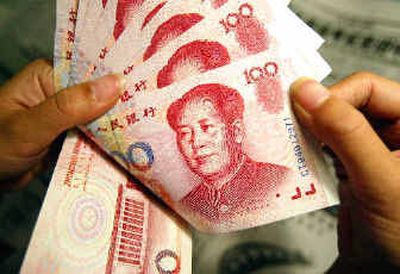
BEIJING — China has no immediate plans to let the value of its currency rise, despite renewed pressure at a weekend meeting of Group of Seven finance officials, the government said Monday.
Lobbying by the United States and others at the G-7 meeting for China to ease tight currency controls had little effect on Asian markets after the G-7 statement simply reiterated last year’s call for more flexible exchange rates.
Beijing stood by its argument that Chinese banks are still too frail to survive the shock of discarding the policy that ties the yuan’s value to the dollar and prevents most trading of the currency.
“China needs more time to reform its banking and financial systems to pave the way for reforming the currency policy,” its central bank governor, Zhou Xiaochuan, who attended the London meeting, said in remarks published in Chinese newspapers.
China’s trading partners complain that the yuan’s exchange rate is set too low, giving Chinese exporters an unfair price advantage. Chinese officials say they plan to let the yuan trade freely eventually, but say doing so now would jeopardize economic growth.
Beijing has fixed the yuan’s exchange rate at 8.28 to the U.S. dollar for more than a decade. The dollar’s recent decline has made the yuan even cheaper in relation to European and Japanese currencies.
The statement from the G-7 — the United States, Britain, Canada, Italy, France, Germany and Japan — emphasized “that more flexibility in exchange rates is desirable for major countries or economic areas that lack such flexibility to promote smooth and widespread adjustments in the international financial system.”
John Taylor, undersecretary for international affairs at the U.S. Treasury, urged China to move to a more flexible currency system “as soon as possible” during talks with Chinese officials.
Despite that, Zhou told reporters in London: “I don’t see much pressure.”
If China were to revalue the yuan, Asian currencies would be expected to strengthen as well.
In trading Monday, the U.S. dollar was up slightly against major Asian currencies, buying 104.50 yen, compared with 104.03 yen late Friday in New York.
“There was nothing new in the G-7 statement,” said Kikuko Takeda, manager of foreign exchange at Mitsubishi Tokyo Financial Group. “There was no new decision on the Chinese yuan, either.”
The United States came under renewed pressure in London about its massive budget and trade deficits, which have pushed the dollar lower. The U.S. government has pledged to halve its budget deficit by 2009, but argues that trade partners concerned about the deficits should speed up their own growth and rely less on exports to the United States.