
U.N. to lead relief effort

BANDA ACEH, Indonesia – World leaders opened an emergency summit today with a moment of silence for the tens of thousands of tsunami victims, before focusing on the best way to rush nearly $4 billion pledged worldwide to millions of survivors.
Secretary of State Colin Powell announced that the group of countries, including the United States, which led initial relief efforts, will now turn its work over to the United Nations.
“The core group helped to catalyze the international response. Now having served its purpose, will fold itself into the broader coordination efforts of the United Nations,” Powell said in remarks presented at the summit.
U.N. Secretary-General Kofi Annan told the gathering that the world was in a race against time to get food, medicine and supplies to the neediest.
“Millions in Asia, Africa, and even in far away countries, are suffering unimaginable trauma and psychological wounds that will take a long time to heal,” he said. “The disaster was so brutal, so quick, and so far-reaching, that we are still struggling to comprehend it.”
He said his organization continued to estimate that the final death toll will surpass 150,000 from the giant waves spawned by a 9.0 earthquake off Indonesia’s northwest coast Dec. 26.
“Although we were powerless to stop the tsunami, together we have the power to stop those next waves,” Annan said, calling for the establishment of a tsunami warning system in the Indian Ocean.
Annan appealed $1.7 billion in disaster relief over the next six months for victims of the tsunami, but it wasn’t immediately clear if that plea included the previous pledges or was a request for more.
Early today, a 6.2-magnitude aftershock centered close to the provincial capital Banda Aceh shook the city. Many residents fled into the streets fearing their homes might collapse, but there were no reports of fresh casualties. Hundreds of quakes have rattled the region since Dec. 26, but Thursday’s was among the strongest.
On Wednesday, Powell and other summit participants got firsthand looks at the apocalyptic landscapes carved out by south Asia’s tsunami.
Powell, a battle-hardened veteran of the Vietnam War, was aghast at the devastation on Indonesia’s Sumatra island. “I’ve never seen anything like this,” he said.
“I cannot begin to imagine the horror that went through the families and all of the people who heard this noise coming and then had their lives snuffed out by this wave,” Powell said. “The power of the wave … to destroy everything in its path is amazing.”
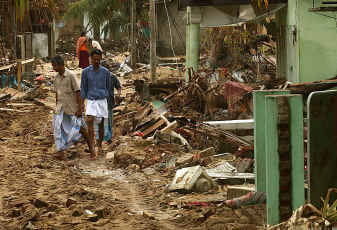
Thousands of survivors of the earthquake and tsunami were still without food, water and basic medical care Wednesday throughout Indonesia’s devastated Aceh province. Medical care remained largely unavailable along much of the 120-mile stretch of coast hit hardest by the underwater earthquake and the deadly waves that came crashing ashore afterward.
Injured refugees reported walking for days before reaching medical help, and volunteers returning from devastated towns said they encountered many refugees too weak or hurt to seek help. The refugees are subsisting on coconut milk and whatever food they can scavenge from the ruins, the volunteers said.
India has politely turned down the unprecedented offers of money and military might, but many Indonesians appeared to be putting pride aside: During Powell’s visit, survivors expressed gratitude for American aid.
“Thank God he’s come. Thank God,” said Mohamed Bachid Madjid, peering from a bridge into the Aceh River, where two bloated corpses floated among the flotsam.
Elsewhere, other countries took time Wednesday to assess the tsunami’s affects on their citizens.
Europe came to a virtual standstill Wednesday as people paused for three minutes at noon to remember the dead. Subways, trains and buses stopped in Amsterdam, Berlin, London, Rome and Stockholm. Schools across the continent fell silent, and in Spain television programs were replaced with black and white photographs of the disaster.
With the death toll among vacationing Swedes likely to top 1,000, Swedish Prime Minister Goran Persson said the disaster was “something we will never forget has happened. We have lost so many, a father, a mother, grandfather, our child, little sister, friend.”
Today’s summit came just hours after some nations increased their pledges, bringing the worldwide total from governments to about $3.8 billion. Australia promised $810 million – the largest so far – topping a $674 million German aid package.
The fresh outpouring of generosity appeared at times to be almost like a bidding war and raised questions about whether rich nations were using tragedy to jockey for influence on the world stage and with hardest-hit Indonesia, which has a wealth of natural resources.
Louis Michel, the European Commissioner for development and humanitarian aid, urged donors not to engage in one-upsmanship. “We have to be careful and not participate in a beauty contest where we are competing to give higher figures,” he said.
But U.N. humanitarian chief Jan Egeland, the man who riled Washington by complaining that wealthy nations were often “stingy,” said Tuesday: “I’d rather see competitive compassion than no compassion.”
The donors’ conference was focusing on how best to allocate the billions in aid following a disaster that wiped out villages and infrastructure, left millions homeless and threatened with disease, and killed more than 139,000 people. Leaders also were to discuss a warning system to prevent massive death tolls from future tsunamis.
The World Health Organization said it urgently needs $60 million to provide safe drinking water, sanitation, shelter, food, medical and other supplies to prevent disease outbreaks that would put another 150,000 people at “extreme risk” of dying. The United Nations announced that camps for up to 500,000 tsunami refugees will be built on Sumatra.
Even impoverished North Korea has chipped in with a pledge of $150,000. Convicts in Malaysia were donating money earned doing prison work, and war-torn Afghanistan planned to send doctors.