
Winter bypasses Europe
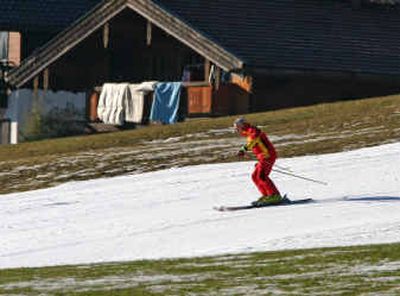
VIENNA, Austria – Bears in Slovakia are awakening early from hibernation. So are barmaids in Bavaria, unseasonably busy in outdoor beer gardens. Bushes are blooming in Austria, and skiers at snowless Bosnian resorts are chilling out in hotel pools.
Forgoing a white Christmas was one thing, but the utter absence of snow for weeks on end from the Baltics to the Balkans has many Europeans pining for what seems – so far, anyway – like The Winter That Wasn’t.
“Hope springs eternal,” Austria’s Kleine Zeitung newspaper headlined Tuesday over a photo of a lone snowflake.
Alpine ski slopes in Austria, Switzerland and France have plenty – so much, in fact, that World Cup races in France’s Val d’Isere were canceled earlier this month because of a snowstorm. But large swaths of the continent haven’t gotten more than a dusting since early December.
Many meteorologists insist it’s normal, but others sense something more sinister in the air.
“In the year 2100, according to our climate models, there will be 50 fewer days of frost. In practical terms, we won’t have winter anymore,” said Mojib Latif, a researcher tracking global warming from Germany’s Leibniz Institute for Sea Science.
Although temperatures have been dropping to near freezing overnight, warm air pumped up from the Azores has produced a string of sunny, balmy days in the low 50s.
Belgium had its warmest Jan. 10 on record, when the mercury peaked at 57.2 degrees in Brussels, breaking the previous mark of 54 set in 1993. Scores of people took to their terraces to soak up the sun, and others strolled along North Sea beaches.
It was even warmer – a touch under 61 – in the southern Czech city of Ceske Budejovice on Saturday, the balmiest Jan. 8 recorded in 230 years.
But while the springlike weather was fine for humans, it was bad for brown bears in parts of the Czech Republic and neighboring Slovakia, some of whom awoke from hibernation as grumpy as anyone roused early from a deep sleep. Naturalists warned that the testy animals were unlikely to fall back asleep and could be dangerous to people later in the season.
Birds also seemed to have been tricked into thinking spring has sprung.
One species that usually doesn’t start singing until late February already was heard in the eastern Beskydy Mountains, and flamingos at a zoo in Jihlava, 75 miles southeast of Prague, were building nests – something they normally don’t do until April.
The unseasonable warmth made the Czech Republic’s Elbe River seem extra cold to 70 hardy swimmers who took their annual winter plunge last weekend. They said they prefer more frigid air temperatures, which make the river seem more comfortable by comparison.
In normally chilly Norway, meteorologists said the first six days of January were the warmest on record since 1938 in Oslo.
Even corners of southern Europe where winter is just a state of mind have been affected. Months of mostly dry, sunny weather have brought drought conditions to parts of Portugal, parching farmland and leaving some reservoirs at 15 percent of capacity, officials warned.
Homeowners farther north weren’t complaining at the prospect of shelling out less cash for utilities.
“Warm weather means low heating bills, so it’s OK with me,” said housewife Nadia Todorova, 36, walking her son to school in Sofia, Bulgaria.
Retailers, too, saw a silver lining.
“It doesn’t bother me that it’s so warm, because people go shopping,” said Crenguta Pruteanu, a clothing store salesman in Cluj, in Romania’s Transylvania region.
The warmth has created unstable conditions in Romania’s Carpathian Mountains and in Austria’s Alps, where authorities raised the avalanche alert to its highest level.
Lack of decent snow conditions prompted World Cup organizers to cancel some events last weekend in southern Germany, where Bavaria’s famed beer gardens opened for scores of thirsty visitors.
“Many people are coming just for the blue skies and sunshine,” said Alexandra Blaha, a spokeswoman for Switzerland’s swanky St. Moritz ski resort, still drawing visitors despite a worrying lack of fresh snow. “But we’d be very happy if it snows again.”
Skiers packed Bosnia’s two best-known resorts, Mount Bjelasnica and Mount Jahorina. But with the slopes largely devoid of snow, most took long walks or relaxed in hotel pools and saunas.
“We go skiing once a year, and for us, lack of snow is the worst thing that can happen,” said a disgusted Ignjat Markov, a student from Serbia. “We spent money to come here, and now we’re playing cards.”