
Excitement now building on shuttle’s return to skies

CAPE CANAVERAL, Fla. – Two years after Columbia’s demise, excitement over the space shuttle fleet’s return to the skies in just a few short months is finally overtaking the agony of the accident.
In the past few weeks, two special deliveries have boosted morale among shuttle workers and provided tangible evidence they are rounding the corner for a possible flight as early as May 12.
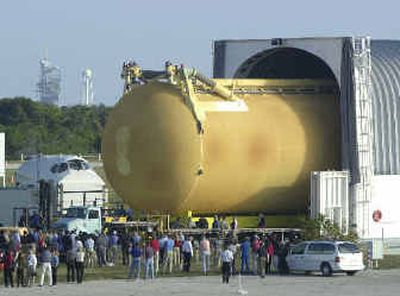
One is a tool to inspect the next shuttle while in orbit for any damage to its thermal-protective skin. The other is a brand new fuel tank guaranteed by NASA not to shed big chunks of foam insulation that could harm the shuttle.
Those are two of the biggest technical changes resulting from a lengthy review of what destroyed Columbia and killed seven astronauts on that still painfully vivid Saturday morning, Feb. 1, 2003.
It’s appropriate, workers say, that two of the most crucial items for safely going into space again are finally at Kennedy Space Center, just in time for the second anniversary of the tragedy.
“We won’t ever forget that. But when we have something like this to work on, it gives us a lot of enthusiasm and pride to focus on the future,” said payload operations manager David Schubert.
He was standing next to a 50-foot inspection boom, the new tool astronauts will use to make sure the shuttle has reached space unscathed.
The spring flight would help the two men aboard the international space station. The shuttle Discovery will deliver groceries and replacement parts.
The fuel tank will be mounted to a pair of booster rockets in just over a week. Discovery will be attached to the threesome in March for the long-awaited trip to the launch pad.
If Discovery is not flying by early June, NASA must wait until mid-July because of the requirement to launch the shuttle in daylight to make sure NASA gets clear photos of the launch to make sure no damage occurred.
NASA guarantees that after two years of scrutiny and re-engineering, nothing bigger than a dinner roll will come off the fuel tank’s foam exterior at liftoff, too small to do the kind of damage that brought down Columbia.
It was a suitcase-size chunk of foam insulation that ripped away during Columbia’s launch and gouged a sizable hole in the left wing. The hole was harmless in orbit, but during re-entry let in atmospheric gases hot enough to melt the wing from the inside out. The shuttle came apart over Texas, just 16 minutes from the Cape Canaveral landing strip where the astronauts’ families and NASA staff were waiting.