
Justice O’Connor retires
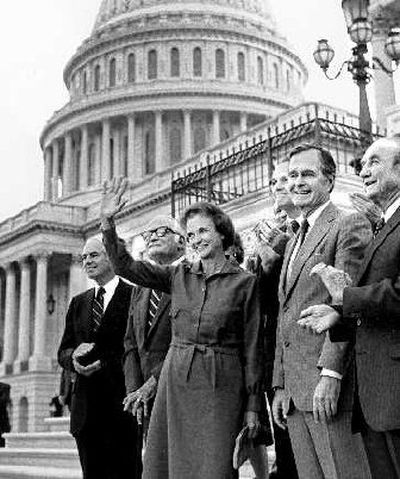
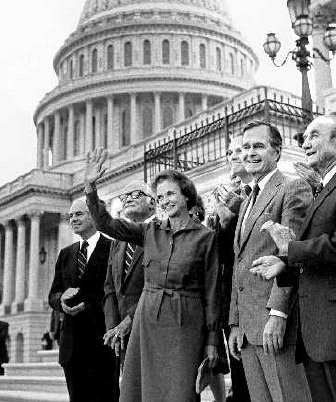
WASHINGTON – Sandra Day O’Connor, the Arizona ranch girl who would become one of the most powerful women in America as the nation’s first female Supreme Court justice, announced her retirement Friday after 24 years on the bench.
In a startling announcement kept secret even from her children, O’Connor informed President Bush by letter that she would step down after her successor was confirmed. The retirement allows Bush to name his first justice to the Supreme Court, although not, as had been widely expected, as a replacement for Chief Justice William Rehnquist.
Because of her role as a swing vote on such a closely divided court, the retirement of the 75-year-old O’Connor gives the president an opportunity to change the court’s balance. The White House said a successor would not be named until at least Friday, after Bush returns from a trip to Europe.
O’Connor’s retirement is the first in 11 years on the high court – the longest period the nine-member panel has gone without a new member – and those on both sides began preparing Friday for a bitter ideological battle over her replacement. Senate Republican leaders said they hoped to have O’Connor’s successor in place for the court’s new term in October, but braced for arduous confirmation hearings in August or September.
Because O’Connor’s successor could transform the direction of the court in such critical areas as race, religion and abortion, the fight for her replacement gained an even greater sense of urgency than, perhaps, had Rehnquist stepped down. Her announcement caught the White House, Congress and an army of interest groups off-guard and set the stage for a new kind of Supreme Court confirmation battle, including a multi-million dollar campaign with all the tension of a tough political race.
“It has been a great privilege, indeed, to have served as a member of the court for 24 terms,” O’Connor wrote in her one-paragraph letter to the president. “I will leave it with enormous respect for the integrity of the court and its role under our constitutional structure.”
Less than an hour after the announcement, Bush paid tribute to O’Connor in the Rose Garden, calling her “a discerning and conscientious judge and public servant of complete integrity.” He said he would nominate a justice who would “faithfully interpret the Constitution and laws of our country.”
O’Connor was plucked from relative obscurity in 1981 as an intermediate-level Arizona state court judge. After graduating third in her class at Stanford Law School, where classmate Rehnquist was first, O’Connor couldn’t get work as a lawyer in California, and moved to Arizona to hang out her own shingle. She served in the state Legislature before becoming a judge.
When President Ronald Reagan offered her a position on the U.S. Supreme Court – fulfilling a campaign wish to nominate the first woman justice in court history – O’Connor said she felt additional pressure because of her gender.
“I’ve always said it’s fine to be the first, but you don’t want to be the last,” she told the Chicago Tribune in a 2003 interview. “I was acutely aware of the negative consequences if I arrived here and did a poor job. It made me hesitant to say yes when the president called.”
O’Connor was the court’s only female justice until President Clinton nominated Ruth Bader Ginsburg in 1993. Judges who could emerge as potential successors to O’Connor include three from the New Orleans-based 5th Circuit Court of Appeals: Edith Brown Clement, Edith Jones and Priscilla Owen. Other possible contenders include Diane S. Sykes of the 7th Circuit Court of Appeals in Chicago and Janice Rogers Brown, a recent controversial appointee to the District of Columbia circuit court of appeals.
“I think that it is very important for there to be gender balance on the court,” said Sen. Arlen Specter, R-Pa., who will oversee the confirmation hearings as chairman of the Senate Judiciary Committee. “I think two is a minimal number.”
Senators said the confirmation battle, though, almost certainly would focus on ideology more than gender.
“Justice O’Connor is a sterling example of what can happen when a president nominates a justice not from the right or the left wing of one of the political parties, but an independent judge capable of making up her own mind,” said Sen. Patrick Leahy of Vermont, the top Democrat on the Judiciary Committee.
In the letter announcing her retirement, O’Connor gave few clues as to what prompted her decision. Her husband, John O’Connor III, suffers from Alzheimer’s disease, and the couple recently sold their home outside Washington to move into a smaller condominium in the city.
After her telephone conversation with the president Friday morning, O’Connor left Washington for a vacation in Wisconsin. She did not give interviews.
In her 24 years on the bench, O’Connor became, in the eyes of many, the court’s most powerful justice. She provided a key vote on high-profile cases in areas of race, religion, abortion and states’ rights, as well as in Bush v. Gore, the controversial decision that stopped vote recounts in Florida and handed the presidency to Bush.
At other times, she tempered the positions of her more conservative colleagues, particularly in religion and voting-rights cases. She also was willing to break ranks to join the more liberal side, as in the landmark case two years ago that upheld the use of affirmative action in college admissions.
“Her overall record was one of a very thoughtful judge who approached each case carefully,” said Andrew McBride, a Washington lawyer who clerked for O’Connor.