
Growing tradition
PULLMAN — Before there was a Boeing or a Microsoft, Washington was the center of an earlier high-tech industry: wheat farming.
This is the 100th anniversary of the creation of the first hybrid wheat at Washington State University. The school is marking the milestone by honoring the handful of scientists who helped sustain a $1 billion industry whose products are exported around the world.
Key to the work is the state winter wheat breeder, a position that only five people have held. The first was William Jasper Spillman, who was hired in 1894 and released his first creation, called Hybrid 60, in 1905.
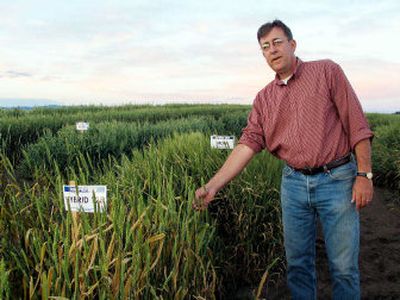
The current state breeder is Stephen Jones, 48, and it is his job to create the new varieties that keep wheat a viable crop in the Northwest.
Wheat is so susceptible to rapidly evolving diseases that new varieties must be constantly discovered to keep the industry alive. Just as jetliners and Windows programs require constant upgrades, so do wheat varieties.
“We wouldn’t be growing wheat in the Pacific Northwest without new varieties,” Jones said during an interview at Washington State.
Wheat is crossbred to make new varieties, incorporating good characteristics and dropping bad ones, such as the tendency to fall down prior to harvest.
Although humans have cultivated wheat for 10,000 years, it is only in the past century that scientific breeding programs became popular, and the Washington State Agricultural College in Pullman was a big player in those early years.
“Before that it was feast or famine,” Jones said, with individual farmers at risk of being wiped out if they chose the wrong variety of wheat to plant.
The first major figure in Washington wheat breeding was Spillman, who arrived in Pullman in 1894. He started a genetics-based program that ultimately led to the creation of some 90 hybrids over the decades. Spillman was hired away by the U.S. Department of Agriculture after eight years.
He was replaced by Edward Gaines, a Harvard-trained geneticist who visited England, Sweden, and Russia in 1930 to collect wheat lines that had resistance to rusts and smuts, both diseases that devastated wheat.
Gaines retired during World War II and was replaced by his protege Orville Vogel. Vogel’s innovation was realizing the need for a shorter, stiffer wheat stalk to support the increased weight of the heads of new varieties pumped up by fertilizers. After years of breeding, Vogel in 1961 released a “semidwarf,” rust-resistant variety he named “Gaines.” It became the foundation for the Green Revolution of the 1960s that dramatically increased wheat production around the world.
Vogel in 1955 also began the acquisition of land that would eventually be called the Spillman Farm, which is used to test new varieties. The farm is celebrating its 50th anniversary this year.
Vogel retired in 1972 as perhaps the most influential wheat breeder in the world.
He was replaced by C.J. Peterson, who created 11 varieties. In 1990 he created Eltan, the most widely grown wheat in the state. Eltan is named for Elmo Tanneberg, a Coulee City wheat farmer.
Jones replaced him in 1995 as state winter wheat breeder and so far has released five varieties, including two this year.
“Everything we do today is based on the success of these individuals,” said Jones, who has a doctorate in genetics from the University of California at Davis, and started at WSU in 1991. “We don’t start from scratch.”
Because the breeder is a state employee, the new varieties are developed jointly with farmers and given to them for free. Most other crops are developed for profit, Jones said. It can take more than a decade to develop a variety to the point it can be released, he said.
The state’s investment of a few hundred thousand dollars a year for wheat breeding is repaid many times over. Jones figures the Gaines and New Gaines varieties of wheat alone were worth a combined $1 billion in revenue to the state’s growers just in the 1960s.
Once a variety is developed, production of seed falls to commercial operators.
There are two other wheat breeding programs at WSU today, one for spring wheat and one for club wheat, with their own breeders. Both programs were started in the 1950’s.
There is a downside to the breeding process, Jones noted. With so many farmers growing the same variety of wheat, a new disease could wipe out half the state’s crop. But the last maor wheat disease outbreak in the Northwest was in 1961.
Jones spends much of his time working in the field with the state’s 2,500 wheat farmers, who are intimately involved in the development of new varieties to keep their $1.2 billion industry alive.
“We learn from them,” Jones said, calling it “participatory breeding.”
The next frontier is to create a wheat hydrid that is perennial, meaning it would not have to be planted from seeds each time. That would sharply reduce the fuel and other costs of wheat farming.
One question he is pondering is whether wheat will remain an important crop in the state 100 years from now. Soil erosion, concerns about fertilizer use, rising transportation costs and foreign competition may eventually end wheat growing in the region, Jones said.
“We don’t know,” Jones said.