
Pots about as old as flowers

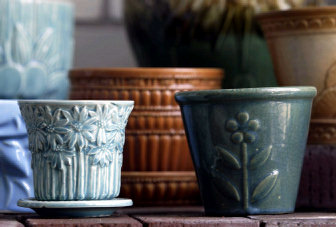
WASHINGTON – Flowerpots have been central to the enjoyment and advance of gardening for at least 10,000 years, and yet our regard for the pot seems as fragile and fleeting as the containers themselves.
Susan Tamulevich, a garden historian and author, is seeking to raise the appreciation for pots and other plant cradles with an unusual exhibition that came to Washington on Saturday. This is the exhibit’s fourth venue this year, and others are planned.
As the show has evolved, Tamulevich, a resident of Branford, Conn., has discovered that the dull and dusty topic of flowerpots is anything but dreary. Flowerpots, she says, connect generations of gardeners as few other icons can. What’s more, the flowerpot looks forward as well as back.
Last week, as Tamulevich was setting up the display in the West Orangerie of the U.S. Botanic Garden, a box arrived from New York. She opened it gingerly, to find a surreal-looking baby bootee of a pot made of silicone that wobbles endlessly once touched. Devised by New York artist Paula Hayes, it would make a distinctly avant-garde statement on your patio – and a pricey one. This model, the tinted medium classic, retails for $5,200.
But the show could only happen, Tamulevich said, because of the current, broad revival of the historic flowerpot. She contrasts the paucity of the 1960s’ plastic pots and machine-made clay containers with the work of flowerpot revivalists in New England and old England, as well as companies such as Seibert & Rice and CollezioneUSA, connecting traditional Italian terra-cotta potters with American gardeners. “We have extinct designs that we are bringing back to life,” she said, “and that’s fun and thrilling.”
As outlandish as the silicone bootee is, it does something no ordinary pot achieves: It expands to accommodate root growth, which gets to another message of the show: Utility. The beauty of a pot, says Tamulevich, is its use to the gardener, of form flowing from function.
To bring home the point, she has placed at the entrance two stylish Medici reproductions, one an urn purely for ornament, the other a decorative pot, but a pot nevertheless.
She picks up the replica of a Dutch greenhouse pot, a smallish 8-inch terra-cotta gem with a shell ornament, but well balanced and with ample handles to keep it safe in the gardener’s grubby hand as it moves from outdoors to greenhouse. Then there are the rolled-rim pots made by artisans in Impruneta, Italy, so that you can get under the lip and move a heavy plant. Machine-made clay pots can’t achieve that, she says.
She shows an orchid pot designed by the 18th-century naturalist Joseph Banks, and other pots commonly in use in the English hothouse in the early 19th century: shallow pots for seedlings, pans for cuttings, elongated flowerpots – long toms – used for bulbs and plants.
She loves the clay blanching jars for rhubarb, which look ancient but were only invented in 1850, and every pot has a tale. The blanching pots came about by accident. Someone dug a trench at the Chelsea Physic Garden in London and dumped the soil over the roots of a rhubarb patch. When the rhubarb was unearthed in the growing season, the stalks were white and, lo, tasted better. So the gardeners started using inverted pots for the same effect. “And then they realized, if you put them on early and packed the sides with manure, you could force it,” she said. The custom-made rhubarb blanchers soon followed.
Most of the early European and American pots in the show are facsimiles made by two artisan potters who have developed an international reputation for their work in reviving antique flowerpots.
At the Whichford Pottery in England, founder Jim Keeling and his potters create reproductions of British and European pots such as the rhubarb forcer ( www.whichfordpottery.com). In New Preston, Conn., Guy Wolff has been reviving pots that were once important to 18th- and 19th-century gardeners in America and were regionally distinctive. Among his terra-cotta recreations are pots from Monticello, rediscovered as shards from an archaeological dig; pots from John Bartram’s nursery in Philadelphia; and pots from Colonial New England gardens.
Tamulevich last year received a shard of a pot unearthed at Mount Vernon, which Wolff brought back to life. The show also features reproductions of ornate and glazed pots unique to various times and regions, including a pot made by Anthony Baecher of Virginia, working before and during the Civil War; and a 1950s green-glazed strawberry pot by a North Carolina potter, Waymon Cole.
Historians thought a 1750 glazed flowerpot from Norwich, Conn., to be one of the first pots in Colonial America, but archaeologists then discovered the remnants of a 3-inch pot made about 1569 at a Spanish settlement on Parris Island, S.C.
In a related event, the Botanic Garden’s Carol Allen and Dayna Lane have turned the popular exterior terraces of the conservatory into a series of 11 displays representing pots and plants in history.