
Training gives feel for military work
FORT LEWIS, Wash. – Half a dozen Army cadets clustered under camouflage netting, peering into the valley below.
“Just say ‘Rock two rounds alpha charlie,’ ” an older Army Ranger sergeant told the cadet holding the radio.
Unseen artillery batteries several miles away fired. High-explosive artillery shells whistled through the sky, making a sound like a distant, fast-moving jet.
“Here comes your round,” the sergeant said.
The concussion rolled over the valley like thunder as the high-explosive shell hammered the ground in the distance.
“There she goes,” the sergeant said.
Thick gray smoke and dust billowed up from each impact.
From June through August, more than 4,500 ROTC cadets from roughly 270 U.S. colleges will train at Fort Lewis, a sprawling Army base near Tacoma.
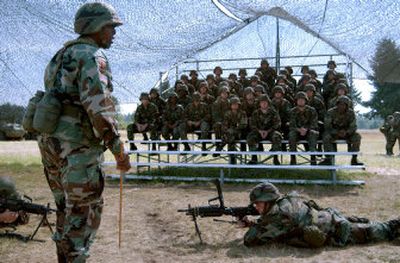
Each of the aspiring Army officers spends more than a month sleeping in a barracks or in the field, firing a wide variety of weapons and learning skills like land navigation. Much of the training covers infantry tactics such as firing, moving and seeking cover.
“We have made the training as realistic as possible,” said Maj. Glenn Kiesewetter, a spokesman for the program, called Warrior Forge.
Cadets are tested for physical fitness, marksmanship, swimming and other skills, but the primary goal is to assess their leadership potential, Kiesewetter said.
“We’re making lieutenants that could be in combat in 16 months,” he said. Those who don’t make it face retraining or dismissal from the ROTC program.
One of the cadets inside the artillery observation post was Robert McQueen, a 23-year-old University of Idaho student.
“It feels good to put it all into practice,” he said. “It gives me a sense of pride I haven’t felt in other things I’ve done. You’re really part of a team.”
With soldiers fighting and dying almost daily in Iraq, military recruiters have struggled this year to sign up enough new troops. By late May, the Army was 6,600 recruits short of its goals for the year to date. Part of the problem, the chief of Army recruiting said in May, is that “influencers” – parents, coaches and others – are now less likely to recommend military service than in previous years.
ROTC cadets – who get college scholarships – typically owe the military four years of active-duty service once they graduate. For some of the cadets at Warrior Forge, the training is their final hurdle before going through basic training for officers and being commissioned.
That’s the next step for South Bend native Aaron Schroeder, 22, an Eastern Washington University graduate. He was won over, he said, by the ROTC recruiter’s passion for the military.
“I just want to work with people who really love what they do and are focused,” Schroeder said, as the popcorn chatter of light machine guns rattled nearby.
“I’ve wanted to go in since I was like 6,” said Miles Hauritz, a 19-year-old University of Idaho history major. “I like being outside, I like adventure, I like weapons.”
“Cock, watch and fire. Say it with me,” Staff Sgt. Joycelyn Johnson told a bunch of cadets. She stood over two prone cadets demonstrating how to load, clear and use the M-249 machine gun.
“Cock, watch and fire,” a chorus of voices responded.
Many of these cadets will likely head to Iraq or similar hotspots, a reality that’s resulted in changes in the training. The cadets now learn about improvised explosive devices used by Iraqi insurgents and terrorists. The infantry tactics now focus more on urban combat, with soldiers freshly returned from Iraq playing the role of opposing forces.
Schroeder said the thought of going to Iraq doesn’t faze him.
“That’s what we’re here for,” he said. “If you’re going to join the military, you have to think about where you’ll be.”
Whitworth College junior Blake Wallick said he made the decision to join after the Sept. 11, 2001, terrorist attacks. And the scholarship, he said, helps.
“This is fulfilling that sense of duty I feel toward the country,” he said. “I also feel it’s what God’s calling me to do.”
So does cadet Yoshinobu Hara, a student at Eastern.
“If my fellow Americans have to be out in the field fighting for freedom, regardless of the political aims, my heart is to be with them,” Hara said. As a Christian, he said, he’s at peace with whatever happens.
“If I have to give my life for my country,” he said, “there’s no better purpose for it.”
Boots and gear rattled as cadets, toting M-16s, gathered around a hulking 155 mm howitzer. A truck loaded with high-explosive shells sat nearby.
“Who here wants to shoot?” barked Army Sgt. Derek White.
After a pause, every cadet’s hand went up.
White had them rattle off the names of their schools. Indiana University. University of Nevada, Las Vegas. Embry Riddle Aeronautical University. Siena College. Marquette University. St. John’s University.
Then White’s artillery crew demonstrated their 155 mm howitzer. A radio operator yelled out coordinates. One soldier dialed in the information. Others rushed to hoist a steel shell and ram it into the firing tube, following it with a green bag of gunpowder. Troops slammed shut the loading door, fitted a primer into the gun, and pulled a lanyard attached to a trigger.
The ground shook as the gun barrel slammed back in its mounts. The shell sailed downrange. Smoke poured out of the gun barrel.
“All right,” White said to the cadets. “Who’s next?”