
Court to hear arguments in favor of Canadian cattle
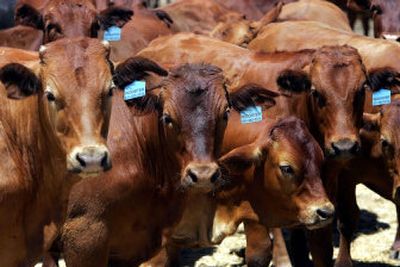
SEATTLE – Whether it’s protecting profits or consumer health, the U.S. meat industry has a lot riding on the Agriculture Department’s effort to reopen the border to Canadian cattle, which have been banned since Canada’s first case of mad cow disease was discovered in May 2003.
The U.S. Department of Agriculture insists it is safe to resume the imports, despite the ruling of a Montana federal judge who sided with U.S. ranchers who fear dire economic and health consequences from a mad cow outbreak in the United States.
Today, a panel of judges from the 9th U.S. Circuit Court of Appeals will hear the Bush administration’s challenge to the ruling by U.S. District Judge Richard F. Cebull of Billings, who said the USDA decision “subjects the entire U.S. beef industry to potentially catastrophic damages” and “presents a genuine risk of death for U.S. consumers.”
Mad cow disease is the common name for bovine spongiform encephalopathy, or BSE. People who eat meat tainted with BSE can contract a degenerative, fatal brain disorder called variant Creutzfeldt-Jakob disease, or vCJD. More than 150 people died from it following a 1986 outbreak in the United Kingdom.
The dispute between ranchers – whose profits have improved slightly without Canadian competition – and feedlots and packers – which have fewer cows to feed and slaughter without Canadian supplies – became more complicated two weeks ago, when the government revealed that a 12-year-old cow born in Texas tested positive for BSE.
Ranchers, who sued under the Montana-based lobbying group Ranchers-Cattlemen Action Legal Fund United Stockgrowers, said the infected Texas cow shows the need for a closed border, to prevent an epidemic.
But Philip Olsson of the National Meat Association, a trade group representing packers, processors, equipment manufacturers and suppliers, said the Texas cow deflates the ranchers’ argument that consumers would lose their appetite for U.S. meat if Canadian cattle were allowed in.
“They’re not telling anybody not to eat their meat now, are they?” Olsson asked.
And some industry watchdogs say the argument is really all about profits, not consumer health. After all, Canadian and U.S. cattle had been cross-breeding for so many years that they are equally at risk, according to The Center for Media and Democracy in Madison, Wis., an advocacy group that has closely followed the issue.
Also, Canada and the United States each test about 1 percent of the herd at slaughter, compared to 25 percent by the European Union and 100 percent in Japan, which has barred both U.S. and Canadian cattle, said Diane Farsetta, a senior researcher at the center whose work supported the 1997 book, “Mad Cow USA: Could the Nightmare Happen Here?”
“Just looking at it strictly from the health perspective, neither Canada nor the United States is doing what it needs to do,” Farsetta said. “There is an artificial political and economic distinction being made between the two countries right now.”
The situation has U.S. ranchers facing down packers and feedlots.
“One fear, if they let those cattle come in and more cases of BSE turn up, we could lose consumer confidence, and people are gonna shy away from us,” said Jon Wooster, who operates a family owned cattle ranch in the Central California town of San Lucas. Wooster says he now sells his cattle for more than 80 cents a pound, and was getting more than $1, up from about 70 cents, right before Canadian cows were banned.
But profits have declined at packers and feedlots, which are paying the higher prices for cattle to process. They say Canada’s cattle are safe, and that the ranchers are more interested in monopolizing supplies than protecting the meat-eating public.
Cody Easterday runs a feedlot that has been in his family for three generations outside the town of Pasco, Wash. He says he may go out of business rather than purchase cows 1,500 miles away in the Midwest, compared to about 550 miles in the Canadian province of Alberta.
“It’s pretty bleak,” he said. “The local processor here is only running about 24 hours a week, compared to 40 to 48 hours a week before. “We all know that the cattle from Canada is safe. This is protectionism.”
The National Meat Association says its members have lost $1.7 billion in revenue because of fewer cows being processed in the U.S., idling some packing houses and prompting layoffs.
Judge Cebull noted that four of 40,000 tested cows in Alberta were found positive, but the Bush administration argues that the four cows were older than 30 months. Scientists believe younger cows present less risk of spreading mad cow disease.