
Envoy to Afghanistan takes over Iraq relations
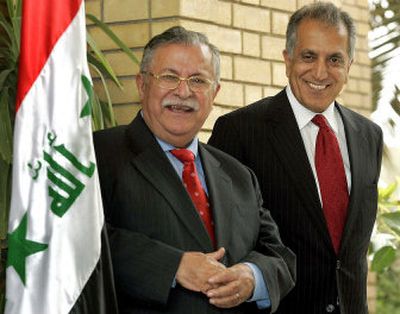
BAGHDAD, Iraq – He is virtually unknown to most Americans. Yet since the day of the Sept. 11 attacks, Zalmay Khalilzad has handled some of his country’s most-delicate diplomatic assignments.
Now, the man known at the White House and CIA as just “Zal” takes on his biggest challenge – running America’s relations with Iraq. As he does, Khalilzad may be forced to scale back the high profile he held as ambassador to Afghanistan, where he met the Afghan president so often that some believed he virtually ran the place.
But Khalilzad, who started his new job Saturday at meetings with Iraq’s president and prime minister, shows no signs of shrinking from sight.
“Iraq is different than Afghanistan, and Afghanistan is different from Iraq – but I am the same person,” Khalilzad said just before heading to Baghdad. “I know the Iraqi leaders and they know me. … If they need my help, I’m going to be available no matter what time it is of the day.”
In one sign Khalilzad has few plans to give up control, he takes the Iraq job even while retaining his title as President Bush’s special envoy to Afghanistan – in effect, making him the point person on America’s two top overseas hot spots.
Yet Iraq is definitely different, with a new government sensitive on the topic of U.S. military occupation and political influence. Already this week, one prominent Iraqi Kurd accused U.S. officials of interfering in the constitution-drafting process.
Nevertheless, Khalilzad already has pushed hard on the constitution, calling its completion by an Aug. 15 deadline vital. He also plans to plunge into another sensitive topic – talks over eventually reducing U.S. military forces here.
Another priority will be improving U.S. reconstruction aid, now widely viewed as lagging and leaving Iraqis demoralized.
“My approach will be to under-promise and over-deliver,” Khalilzad said Saturday.
It is Khalilzad’s closeness to Bush, to Vice President Dick Cheney and to Defense Secretary Donald H. Rumsfeld that many view as the source of his influence.
He worked under Cheney when Cheney was defense secretary for the first President Bush, then served as the second Bush administration’s transition head at the Pentagon. After that, Khalilzad moved to the White House’s National Security Council – the inner circle of foreign policy advisers to the president.
During the war to oust the Taliban, Khalilzad worked closely with the Pentagon.
He never shied from offering his opinions, earning a reputation as the true power behind U.S.-backed President Hamid Karzai.
Khalilzad’s influence was on view last October when crucial presidential elections were threatened by Karzai’s rivals’ decision to boycott the vote. The U.S. ambassador raced around Kabul, meeting each politician individually until he successfully convinced each to drop the protest.
Such prominence brought security threats: Afghan intelligence agents said they scuttled a plot to assassinate Khalilzad in June – just the latest in a string of attempts, U.S. officials say.
Even while busy with Afghanistan, Khalilzad had a hand in Iraq.
Before the U.S.-led invasion to topple Saddam Hussein in March 2003, Khalilzad was a special envoy to the Iraqi opposition and held a key prewar meeting with opposition leaders in Kurdistan.