
Hawaii’s winged friends are starting to disappear

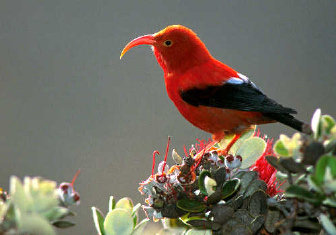
WAIMEA, Hawaii – Bird calls ricochet among the trees in a patch of native forest on Mauna Loa’s lower slopes, but the birds themselves are so evasive we sometimes spend minutes scanning the towering koa canopy to glimpse even a flicker of their small shadows.
A phalanx of binoculars goes up as a far-off silhouette wings closer and lands on a high branch overhead. The bright red bird with a slender, curved bill, an i’iwi, matches the coloring of the pom-pom-shaped lehua blossoms whose nectar it sips. The i’iwi perches for less than a minute, then launches off the branch and flits out of view on its black-edged wings.
I’iwi birds are common during winter when lehua blossoms flower on the ohia trees in this kipuka, a tract of Hawaiian forest protected from marauding herbivores by an old lava flow, said our birding guide, Garry Dean.
“In winter there are so many of them flying around, that’s when they become ‘trash birds,”’ Dean said. “But today they are one of our target birds.”
Dozens of bird species once filled the formerly thick forests of the Hawaiian Islands before logging, cattle ranching and feral animals introduced in the last two centuries – such as European boars, sheep and goats – razed and uprooted most of the birds’ habitat.
But now 28 percent of Hawaii’s 93 native bird species are extinct and another one-third are listed on the federal threatened and endangered species lists, according to figures released in 2000 from the U.S. Fish and Wildlife Service.
The Hawaiian Islands harbor 317 of the nation’s 1,264 endangered and threatened plants and animals, according to the agency’s latest figures from this year. More than half of the 31 avian species on the list from Hawaii are small forest birds.
The quick eyes of Dean and tourist Meade Cadot, who leads bird treks in New Hampshire, pick out many native birds over the next couple hours, including the grayish oma’o, which feeds on berries; the brown elepaio, trimmed with black and white; the bright red i’iwi and like-hued, but shorter-beaked apapane, found often near lehua blossoms; the yellow and fairly common amakihi; and the endangered Hawaii creeper, one of the plumper forest birds.
Dean spots the endangered akiapola’au, one of our target birds, creeping along a branch. The yellow-green bird, who does the job of a woodpecker, begins hammering away at the bark with its lower beak. Termed the “Swiss Army knife” of Hawaii’s bird world by scientist and photographer Jack Jeffrey, the akiapolaau uses its long, curved upper beak to spear grubs.
There were no great photos or commemorative trinkets to take home. In fact, I only got one grainy photo of a pueo and can’t even remember what some of the birds looked like in the sights of my binoculars.
But a reminder of our trek was a checklist of Big Island birds provided by the tour company, which I admittedly enjoyed filling out on the flight back to Honolulu.
Contact: Hawaii Forest and Trail Adventures, www.hawaii-forest.com or (800) 464-1993.