
Women climb for breast cancer
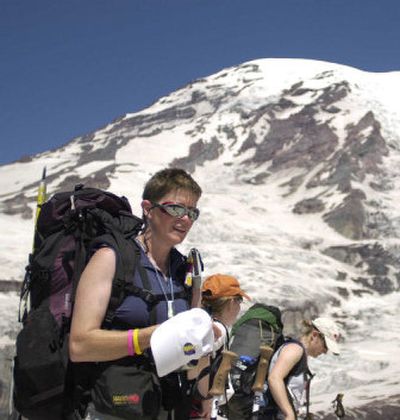
MOUNT RAINIER NATIONAL PARK – Sherry Miller took one last deep breath, fought back tears, hugged her partner and turned to begin a long trek up a towering mountain.
She wasn’t alone. Over three days, nearly 40 women laughed and cried together as they slowly ascended Mount Rainier – mothers, sisters, daughters and friends joined in the mutual goals of reaching the summit, and more importantly, raising awareness about breast cancer.
Not all would reach the top, and the struggle was especially grueling for some. Miller, a breast cancer survivor, had completed her third go-round with chemotherapy just six months ago.
But there is a will among breast cancer survivors that those who have never had the disease cannot even fathom, said Jeanne Rizzo, executive director of the Breast Cancer Fund.
“They have faced something way beyond what they face on that mountain, and they take that with them,” she said.
The climb was the sixth undertaken by the nonprofit and the first at Mount Rainier. Washington state has the highest rate of breast cancer among women in the nation, according to the National Cancer Institute. Gov. Christine Gregoire won the state’s highest office last year after undergoing breast cancer surgery at the beginning of her campaign.
Several groups have raised money for breast cancer research, prevention and treatment by scaling the state’s storied peaks: Rainier, Adams, Baker. Many use mountain climbing as a metaphor for beating the disease, even though there are easier ways to raise money.
“Someone in New Jersey or Pittsburgh goes to their family and says, ‘I’m climbing a mountain,’ ” Rizzo said. “They’re not walking in a park; they’re not on a bike ride.”
Climbing a mountain creates dialogue, she said, and dialogue sparks access.
Climber Sibyl Diver, 31, of Seattle aimed to raise awareness about potential links between toxic chemicals and breast cancer. An employee of the Toxic Free Legacy Coalition, an alliance of 50 groups working to eliminate toxic chemicals in Washington state, Diver was on her first climb.
“This is an important time for us. We have some great opportunities to eliminate toxic chemicals and improve our environment and public health,” Diver said while applying sunscreen during her group’s first break at Panorama Point, about two miles up.
At the trailhead, Bob Keeley of Chicago serenaded climbers with his trombone, as wife Chris, 65, trekked in memory of the mother she lost 20 years ago.
A marketing and sales representative for Boeing, 25-year-old Jamie Rosen climbed for her grandmother and several family friends who have died.
Then there were the survivors themselves. Doctors on the team closely monitored several women, including Miller.
It took a mammogram to uncover a lump for the 50-year-old cabinetmaker from Reno, Nev., in 1998. Her sister had been diagnosed with breast cancer just six months earlier, and friends and family were stunned to hear Sherry had the disease as well.
Fit, athletic and active, she was a poster child for healthy living. But the disease was caught early, and surgery and chemotherapy appeared to cure it.
Then in 2003, only a few months short of the five-year anniversary that is often considered a cancer survivor’s safety zone from recurrence, doctors found cancer cells in Miller’s lungs.
More aggressive chemotherapy left peeling burns on the palms of her hands and soles of her feet, leaving Miller uncomfortable and struggling to work.
She and her partner of 21 years, Tamela Gorden, purposely put off the next scan until after Miller’s 50th birthday last fall. The results proved devastating: two tumors on her liver.
Miller had already been thinking about attempting the climb. The third cancer diagnosis pushed her decision.
“If not now, maybe never,” she said. “I’m still around to try, and by doing this, I’m showing my family and my friends I’m OK.”
The Breast Cancer Fund’s first climb, in 1995, raised more than $1 million, as 17 breast cancer survivors and their supporters scaled Mount Aconcagua in Argentina. Since then, climbers have scaled Alaska’s Mount McKinley, Mount Fuji in Japan and Mount Shasta in California, raising about $3 million, Rizzo said.
The decision to climb Mount Rainier represented a special moment for the organization, Rizzo said.
The 14,411-foot peak is considered a technical, difficult climb. In order to attempt it, climbers must have a certain level of skill.
“We felt we had enough seasoned veterans who knew and understood how to train, and secondly, that we could instill in them this is still about the journey, not the summit,” Rizzo said.
Miller, a rookie mountain climber, echoed that sentiment before starting up the mountain, pointing to the $13,510 she raised for the climb.
On Thursday, she advanced to 12,600 feet before halting.
“A month ago, I would have been devastated if I didn’t make it to the top. Now, I think I’ll survive it,” she said. “Cancer has touched a lot of people. It means a lot to me that I can do something for those people it’s touched.”