
Exit from Iraq could start in spring, U.S. general says
BAGHDAD, Iraq – The top U.S. military leader in Iraq said Wednesday there could be substantial withdrawals of some of the 135,000 U.S. troops in the country as early as next spring.
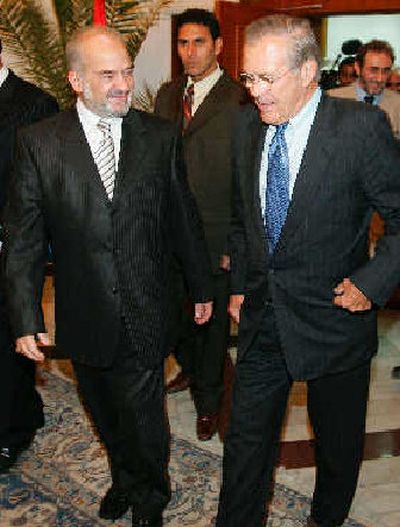
Gen. George Casey said that despite continued lethal attacks by insurgents, the security situation in Iraq had improved. He reiterated a position he had taken earlier this year on the possible decrease in the U.S. military presence during a one-day visit by Defense Secretary Donald Rumsfeld for meetings with Prime Minister Ibrahim al-Jaafari.
Casey spoke on a day in which officials reported that 16 people were killed by insurgents, including two Algerian diplomats who had been kidnapped last week.
“If the political process continues to go positively, and if the development of the security forces continues to go as it is going, I do believe we’ll still be able to take some fairly substantial reductions after these elections in the spring and summer,” Casey said before meeting with al-Jaafari.
While U.S. officials have said recently that troop cutbacks are possible, Rumsfeld’s visit gave special focus to the prospects for withdrawals. Rumsfeld and other officials have rejected making a deadline public, but a secret British defense memo leaked earlier this month in London said that U.S. officials favored “a relatively bold reduction in force numbers.”
Rumsfeld did not discuss troop levels specifically on Wednesday, but he linked the overall security situation to Iraqi military training and political progress toward completing a draft constitution by next month.
Failing to meet the deadline for passage of a new constitution “would be very harmful to the momentum that’s necessary,” Rumsfeld told reporters traveling with him to Baghdad. “We have troops on the ground there, people get killed,” he said.
Iraqi leaders have also said consistently that U.S. troops should leave as soon as the U.S.-trained Iraqi army is ready to fight the insurgency and defend the country, but have estimated the time needed for that at from 18 months to five years.
“The great desire of the Iraqi people is to see the coalition forces be on their way out as they take more responsibility,” al-Jaafari said at a news conference with Rumsfeld after their noon meeting in Baghdad.
But al-Jaafari said a withdrawal would require “picking up the pace of training Iraqi forces,” as well as carefully synchronizing the U.S. withdrawal as Iraqi forces took charge of different parts of the country.
“The withdrawal should be whenever the Iraqi forces are ready to stand up,” al-Jaafari said. “We don’t want the Multinational Force to have a surprise departure.”
Earlier this month, a report prepared by Gen. Peter Pace, the incoming chairman of the Joint Chiefs of Staff, concluded that only a “small number” of Iraqi forces were capable of fighting insurgents without U.S. assistance.
Two-thirds of Iraqi forces are “partially capable” of counterinsurgency missions if they have U.S. support, Pace concluded.
Since al-Jaafari took office on April 28, there has been a marked escalation of insurgent attacks in Iraq. Daily death tolls from suicide bombings, ambushes and other attacks have been in the double digits most days this month.
In violence Wednesday, the insurgent group that calls itself al Qaeda in Iraq said it had killed two Algerian diplomats who were seized last week. Algerian President Abdelaziz Bouteflika called the killings of his country’s chief envoy, Ali Belaroussi, and fellow diplomat Azzedine Belkadi “odious” and cowardly. He vowed to pursue the killers. Such kidnappings have driven many other Middle Eastern embassy officials to leave the country.
One U.S. soldier and six Iraqis were killed Wednesday in mortar attacks, bombings and ambushes, and Iraq’s Defense Ministry reported that seven Iraqi soldiers had been killed by grenades and gunfire as they guarded a water plant Tuesday.
Casey suggested that the insurgency in Iraq was stagnating and that “the level of attacks they’ve been able to generate has not increased substantially over what we’ve seen over the past year.”
A top U.S. commander in Iraq, Lt. Gen. John R. Vines, told reporters last month that four or five of 17 battalions, roughly one-quarter of U.S. forces in Iraq, could be pulled out if security conditions improved and if Iraqi national elections scheduled for December went smoothly.
The elections are supposed to follow an October referendum on the constitution. Iraqi Shiite, Sunni and Kurdish leaders negotiating the constitution still have major disagreements.