
Millwood’s Cliff Rurey a talented worker, athlete
Clifford Rurey was a young father in a valley full of young fathers desperate for full-time work in the late 1930s. The men took whatever was offered, three days of work when they needed five, a dollar an hour when they needed two.
But Rurey had an advantage the others didn’t have. He played baseball at a time when baseball was king, and even local company leagues were serious business. Being able to change the outcome of a game made him a more attractive hire.
“His primary claim to fame was he was a super left-handed pitcher,” said Rurey’s son, David. “He pitched for Inland Empire Paper and Wonder Bread. He had pro scouts looking at him, but mom didn’t like that.”
Clifford Rurey or “Cliff” as most knew him, died July 9, six weeks shy of his 93rd birthday. He lived almost his entire life in the Millwood area where some still remember his athletic achievements. He once punted a football 73 yards and averaged better than 40 yards a punt while playing for West Valley High School. He was the high points getter in track and field.
“As far as I can remember, he was a prince, an awfully nice man,” said Evelyn Harmon. “He was an athlete, and everybody liked him. When I met him, he was going with my friend and he married her.”
Harmon’s friend, Irene Shaeffer, married Rurey right out of high school, where they were classmates. Rurey was a big man on the West Valley campus, but he wasn’t big physically. He’d nearly died from rheumatic fever as a child in Peck, Idaho, a little town several miles east of Lewiston. The sickness was thought to have left him slight, though he had an athletic pedigree few could claim. Rurey’s uncle, Leon “Pat” Perrine was a member of the U.S. Olympic track team in the 1920s.
The fever kept Rurey out of school for some time, which, coupled with the quality of the Peck country school when compared to West Valley, set him back three years academically.
Rurey may never have had to skip a grade, but for a change in Idaho law that essentially brought his father’s vocation to an abrupt end.
The Rureys were country people, who lived on a farm passed down through Rurey’s mother’s side of the family. His father was a self-educated veterinarian, which was good enough for Peck, but not accepted by the Idaho Legislature, which early in the 20th century passed laws requiring veterinarians to be certified. Rurey’s parents weighed the merits of sending his father to school for formal training, but instead settled on Spokane where jobs are more numerous and wages were better.
Rurey’s father took a job with the railroad, and the family moved to Millwood, where Rurey landed a job delivering the newspaper.
“He used to say he knew every house as a boy growing up in Millwood because he delivered the newspaper,” said Cliff Rurey’s son, Les.
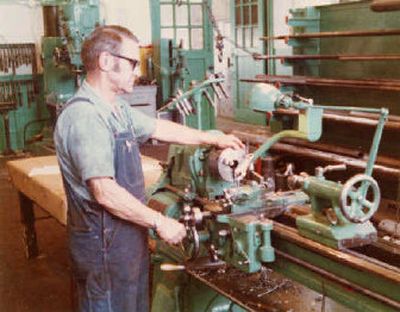
Upon graduating, Rurey learned the ins and outs of the town’s factory. He was a machinist capable of making anything out of metal. Inland Empire Paper hired Rurey to make whatever parts the company might need to keep the paper mill running. But the job didn’t last because Rurey couldn’t get the hours he needed.
“Dad had a supervisor who said he couldn’t give him more hours. He told Dad, ‘I can only give you so much work,’ ” Les Rurey said. “Dad said he was going to look for another job and the supervisor said, ‘Well, if you quit me, you’ll never get another job here as long as I am here.’ And Dad didn’t.”
Rurey left Inland Empire Paper and worked a handful of machinist jobs for other companies. He worked for Alcoa Aluminum Works in Mead, Union Iron Works and General Machinery.
There was nothing Rurey couldn’t do with his hands, said Les Rurey. He built the family’s home on Upriver Drive just west of Hutton Settlement. He fixed every car he ever bought, not out of some fascination with auto mechanics, but because he could, which made it the practical thing to do.
“I remember having a Model A Ford in high school. I didn’t know anything about cars. It would break down, and Dad would fix it,” Les Rurey said.
In his later years, Rurey would fix cars for anyone in need and charge only about $5 an hour. He just liked helping people out, and fixing cars gave him something to do.
As adept Rurey was in the garage, his wife, Irene, was the master of the house. She was a pie baker, homemaker, the kind of woman who could quickly transform her home into a Good Housekeeping photo spread when the ladies from The Church of the Nazarene were stopping by.
Both Les and David Rurey described their parents as sweethearts, the kind of spouses who affectionately refer to each other as “Honey,” or “Mom,” or “Dad,” without ever wearing the words thin.
“My mom,” Les Rurey said. “I never heard her utter a swear word in my whole life. She was a gentle person. She was a very humble, giving woman.”
Irene Rurey died Nov. 2, 2002, after a long struggle with Alzheimer’s. In the years leading up to her death, she was eventually admitted to a residential care facility, but not before caring for her at home became too much for Cliff Rurey, their son David said.
Rurey did everything he could to keep his sweetheart at home and actually suffered a broken leg maneuvering Irene’s wheelchair, which had become too much for him.
After his wife’s death, Rurey remained in the house they built together. And, according to his sons, Rurey became the reliable friend to every widow in the neighborhood who needed a car fixed or a driveway cleared of snow. Even in old age, Rurey seemed more physically capable than his surviving peers and more than willing to help out. He never said no to anyone, right up until his death, which occurred quietly one day after he’d mowed his lawn.
“I can honestly say to you with 100 percent confidence, that you wouldn’t ever hear anyone say one negative thing about my father,” Les Rurey said. “That’s pretty damn good.”