
Loyal Blair awaits reward from Bush
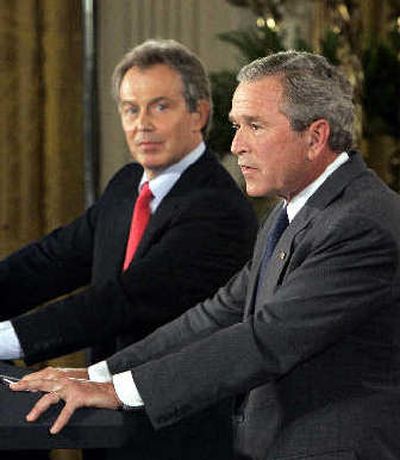
WASHINGTON – For Tony Blair, the price of supporting President Bush on Iraq has been high: loss of public trust and sharp election setbacks for his Labour Party. If any leader seemed due some political payback, Blair would be the one.
Yet, the British prime minister still has little to show for his steadfast loyalty to Bush.
On Tuesday, Blair came looking for more U.S. aid on African famine relief and for American concessions on global warming, the two subjects he hopes to highlight when he hosts a meeting of eight wealthy democracies next month in Gleneagles, Scotland.
The two leaders said they were close to agreement on a plan to forgive 100 percent of the debt for certain developing African countries, and Bush pledged a more immediate $674 million for famine relief. But the overall U.S. response wasn’t as generous as Blair had sought. And Bush offered Blair little support on mobilizing world leaders on climate change.
Still, Blair was able to achieve something he hadn’t before: He brought his own playbook, helping to change the subject – if only for a while – away from the bloodshed in Iraq.
“What we saw was Tony Blair coming to Washington and saying, ‘Now I want to pursue my agenda. And my agenda is dealing with poverty, dealing with Africa, dealing with global warming,’ ” said Ivo H. Daalder, who was director of European affairs in the National Security Council in the Clinton administration.
“He wanted to prove that he was not George Bush’s ‘poodle,’ ” said Daalder, now a foreign policy fellow at the Brookings Institution.
That’s not to say the insurgency in Iraq, violence in Afghanistan and nuclear tensions with North Korea and Iran didn’t command the attention of the two leaders. Still, Blair was able to emphasize his current priorities. Three of the four questions at their news conference dealt with those issues. The fourth dealt with Iraq.
Both Bush and Blair suffered political damage because of Iraq, yet both were re-elected.
Blair was hurt politically more than Bush. While the president increased his margin of victory in 2004 from that of 2000, Blair’s Labour Party suffered heavy losses in last month’s parliamentary elections.
Amid calls for his early resignation, Blair said he would not run again. Britain’s treasury chief, Gordon Brown, is poised to take over should Blair not complete his four-year term.
“Tony Blair is probably more popular in the United States than he is in Britain,” said Michael Mandelbaum, a professor of American foreign policy at Johns Hopkins University. “It happens to some foreign leaders. It happened to (former Soviet leader Mikhail) Gorbachev.”
Blair’s trip to Washington, and his hosting of the Group of Eight summit in Scotland in July, “is a way of changing the subject, pushing issues that matter to the base of his party, which was vehemently opposed to the Iraq war,” said Mandelbaum.
Sometimes lost in the blur of their march to bring democracy to Iraq is the extent to which Bush and Blair disagree on a range of other subjects and world issues.