
Avista seeks separate license
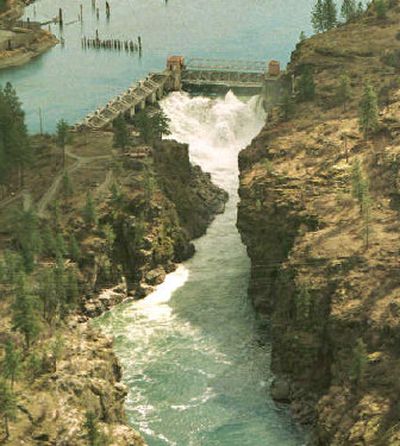
Avista Corp. said Friday that it will seek a separate license to operate its Post Falls dam, a controversial move in the midst of a heated relicensing battle.
Relicensing has pitted Lake Coeur d’Alene interests against those advocating more water for the Spokane River. But both are now united in their opposition to Avista’s new effort to separate the dam at Post Falls from the company’s four others on the Spokane River.
“What they propose is wholly inappropriate and doesn’t make any sense at all,” said Howard Funke, attorney for the Coeur d’Alene Tribe. “Post Falls and the others are operated in a coordinated fashion. They are one project.”
Avista’s action threatens to unravel years of work toward a compromise, Funke said, and it could add more problems to an already contentious issue.
“This may be a strategy of divide and conquer,” said Rick Eichstaedt, an attorney with Center for Justice, a group representing the Sierra Club on Spokane River issues. “It may make this process even more adversarial.”
Avista spokesman Hugh Imhof said the company wants to sever the contentiousness of the Post Falls dam from the company’s other four Spokane River dams.
By law, Avista has until Aug. 1 to submit a proposal to the Federal Energy Regulatory Commission to relicense the dams for 30 to 50 years.
Avista will need approval from FERC to split off the Post Falls dam, but the Aug. 1 deadline is firm.
To earn a license, utilities attempt to reach a compromise with interested groups such as businesses, property owners, regulators, recreationists and conservationists to operate dams in a way that is most beneficial for all.
In this case, Avista has been working for several years to relicense the whole of its Spokane River project, which includes dams at Post Falls; two in downtown Spokane at Upper Falls and Monroe Street; the Nine Mile dam and the Long Lake dam. Two Spokane River dams are not part of the relicensing effort: Upriver Dam, which is owned by the city of Spokane, and Little Falls Dam, which is owned by Avista.
There are few issues regarding the lower four dams. But settlement for the Post Falls dam has proven elusive.
There are those advocating that it should be carefully managed to benefit Lake Coeur d’Alene and its wetlands, fishery and property interests, and those advocating that Avista should use the dam to wash more water into the Spokane River to help fish and dilute pollutants discharged by sewage treatment plants and industry.
Avista also has struggled with the tribal demands and issues raised by the Bureau of Indian Affairs and the U.S. Fish and Wildlife Service. The tribe owns the southern third of Lake Coeur d’Alene.
“In our case, we’re in a position where it could become uneconomical to operate that dam,” Imhof said. Avista has an obligation to its shareholders and customers to provide energy at the lowest cost possible, he said.
Though it can generate about 14 megawatts of electricity, the dam’s real use is water storage and flow control.
It helps regulate lake levels and is important for supplying late-summer water into the river to spin turbines, including those at the 88-megawatt Long Lake dam.
Funke speculated that Avista may want to sever the Post Falls dam from the others for financial reasons. Separated from the larger Spokane River project, Avista may be better able to argue that the economics of running the dam would be jeopardized by the various conditions placed on it by federal regulators.
Said Imhof: “Our goal from day one has been to arrive at an agreement. We would be happy to have a single license, but right now it looks like doing that might make it difficult to operate economically.”
It’s worth more work, said Eichstaedt.
“This risks a messy, adversarial proceeding beyond what we’ve had so far,” he said. “As a practical matter it would not be very efficient. Instead of having one comprehensive plan to help us manage our river, we would have two.”