
West Valley will start projects-based school

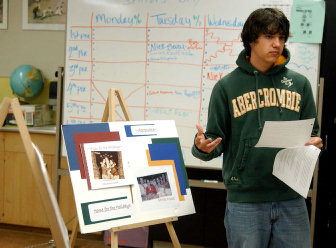
High school students who have trouble sitting through the traditional classroom lecture may feel at home next year in the West Valley School District.
The district was awarded a $150,000 grant from a Minnesota-based education cooperative funded by the Gates Foundation to start a project-based high school next year.
The school will be open to 40 to 50 public school students in grades nine through 12.
Students will be offered the opportunity to complete hands-on projects in lieu of traditional classroom instruction to fulfill graduation requirements mandated by the state.
“It is definitely a departure from the traditional seat-time, where the teacher is up on a stage,” said Steve Lawler, a West Valley High School teacher. “The students are basically designing their own education based on their interests.”
Lawler directed a pilot of the project-based program in his classes at West Valley High School this year, where some students completed projects for credit. The projects were similar to those planned at the new school.
Each student did research, wrote a paper, and spent time with a working professional. They then presented their findings to Lawler and other students. The projects ranged in subject from psychology to advertising and biology to art.
“The whole point is to do something you want to do,” said Nick Sevey, 18, a West Valley senior who took one of the pilot classes. “In this class you are basically self-motivated, and I feel like I can learn whatever I am curious about.”
The grant was awarded by EdVisions Cooperative, a group devoted to creating innovative alternatives to the traditional classroom setting. The organization’s efforts are in collaboration with the Gates’ mission to create smaller learning communities.
West Valley will be one of the first public school districts in Washington to replicate the EdVisions model, Thomas said.
“Since Washington doesn’t have a charter law, they technically have to go through the district,” Thomas said.
Thomas said EdVisions selected West Valley because of its willingness to explore different approaches to the traditional classroom.
The district already operates two alternative high schools, Contract Based Education and Spokane Valley High School, for nontraditional students, and the West Valley City School, a choice school with 130 students in grades five through eight.
The schools, like the new project-based high school, are open to all students in the Spokane area. There is no cost to attend.
“We also think that they have pretty good leadership both at the district level and at the teacher level. Those are really the two things we really look for in creating these models,” Thomas said.
EdVisions operates 23 public charter schools in seven states, including Oregon and California, all of which are replications of the organization’s flagship, the Minnesota New Country School.
The Minnesota school houses 110 students in grades seven through 12, and is directed entirely by its seven teachers – about 15 students per teacher.
The students are self-directed, choosing their own curricula with guidance from their teachers. All projects must incorporate the state standards required of all public school students.
“I think there is more and more people in the country understanding and realizing that the traditional way kids are educated is not meeting the needs of all the students,” said Doug Thomas, the director of EdVisions, based in Henderson, Minn. “It’s a combination of kids of who are really bored with the traditional system, and some who have not done very well because the learning style just doesn’t fit them anymore.”
West Valley’s project school will be housed at the Millwood Early Childhood Education Center, 8818 E. Grace Ave., and directed by two teachers, which the district has already committed to hiring. The teachers will be governed by a five-member board which will eventually be made up of parents and community members.
For now, that board is made up of administrators from the district, including the City School.
“We’re definitely trying to put something out there that is attractive to a different type of learner,” said Polly Crowley, West Valley superintendent. “We think this is a wonderful model for certain gifted kids who are bored with the normal classroom.”
Crowley hopes the school will attract kids from both inside and outside of West Valley’s enrollment boundaries, with preference given to West Valley students. Eventually the district would like to see an enrollment of 150 at the school.
One challenge of the program will be preparing the 10th grade project-based students for the Washington Assessment of Student Learning.
The WASL test, Washington’s answer to the federal No Child Left Behind Law, is given each year to students in fourth, seventh and 10th grades.
Beginning with the class of 2008, every 10th-grade student must pass the WASL in order to receive a high school diploma.
“We’ll definitely want to take a look at how successful those students coming in (to the new program) have been in the past,” Crowley said.
For example, they could look at a student’s seventh grade WASL score, as one measure of success, Crowley said.
Crowley said some students will likely be taking regular math courses at West Valley High School, because those lessons are hard to replicate with projects.
“We’re just not sure what it all will look like yet,” Crowley said.
Students in the program could still choose to take some courses at West Valley High School or one of the alternative schools and will have access to all extra-curricular activities at those schools, including athletics.
“We haven’t developed real specific parameters yet,” Crowley said. “We wanted to wait until we have those two teachers in place,” since they will be running the school.
The grant money, distributed over three years, will be spent on planning. The teacher salaries will come out of the district’s budget, Crowley said.