
Fouling the nest
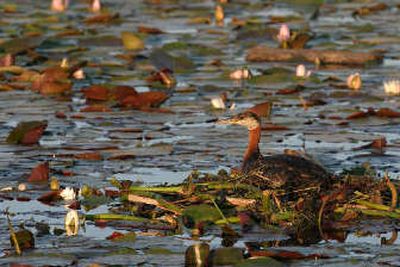
Some of the earliest residents on Inland Northwest waters are being crowded off Loon Lake. Small remaining colonies of red-necked grebes have had poor nesting success in recent years, and the situation is worse this spring, according to local bird watchers. Efforts to help the loon-like birds cope with boat wakes that swamp their lake-level nests are suddenly being met with outright harassment.
Some of the floating nest platforms built by volunteers to improve grebe nesting success were stolen shortly after they were installed in April, according to the Loon Lake Loon Association.
Several platforms that remain in the lake’s wetland areas are being targeted as fishing hot spots by a few anglers indifferent to driving the birds off their nests and leaving the eggs exposed.
“I can’t imagine why a fisherman would purposely bump up against a platform, drive a bird off a nest and just sit there and keep fishing,” said Red Crass, a longtime Loon Lake resident.
The harassment isn’t accidental, he said, noting that some of the nest platforms have big orange signs that say, “Waterfowl nesting area. Please stay away.”
Ginger Gumm, a member of the Loon Lake Loon Association, said she recently watched as anglers in one bass-fishing-type boat fished and moved from nest to nest, eventually tipping one platform so that the nest slid off into the water.
Crass is personally offended because he devoted considerable time to building and installing the nesting platforms that are being abused as well as the ones that were cut from their concrete block anchors and taken away.
But don’t write-him off as some narrow-minded birdwatcher oblivious to the sport of fishing.
Crass has volunteered countless hours to maintain the net-pens in Loon Lake where he raises the young rainbow trout through the winter so they can be released to boost success for all anglers who come to the lake he calls home.
“We’ve put out the grebe nests for 13 years and this is the first year we’ve ever had a problem with people messing with them,” he said.
Grebes are divers that swim underwater to feed on aquatic creatures. They are weak flyers, requiring a long run on top of the water before they become airborne. When disturbed, they prefer to dive.
Mike Whorton, the department’s regional enforcement chief, said that purposely harassing protected wildlife is unlawful. “It sounds like there’s a need for some more education,” he said, noting three statutes that deal with protecting the nests of protected species.
“Often we use those laws in cases when people deliberately let their dogs run where they know the dogs will probably get into the nests of protected birds,” he said. But what’s going on at Loon Lake seems unusual, he added.
“Occasionally we get reports of speed boaters or jet skiers running down nesting geese pairs,” he said.
Gumm and Dan Poleschook Jr., loon association members who have a home on the lake’s northeast bay, wonder if some of the harassment stems from their attempts to protect the lake’s few remaining wetlands.
“There’s a longtime effort to preserve what’s left of the marsh systems at Loon Lake,” Poleschook said. “We’ve tried to get a wakeless speed zone through the marshes that total about 5 percent of the lake because we know wakes have a big effect on the colony of red-necked grebes and other birds.
“When the Loon Lake home owners association and the Loon Lake Loon Association went before the Stevens County commissioners, there was some vocal opposition from people who said we were trying to shut down water skiing and fishing. But we weren’t asking to exclude people, we just asked for small speed zones.”
A small no-wake zone in the marshy portion of the northeast bay might be a safety measure to warn boaters who sometimes tow wakeboarders through water that’s only two feet deep, Gumm said.
The issue could be exacerbated this year because of frustration with lower lake levels caused by drought, Gumm said.
“The lake is down about two feet and a few homeowners in shallow bays can’t get their boats in and out of their docks,” she said. “A few have suggested dredging and maybe they’re afraid that protecting wetlands would prevent that.”
Gumm and Poleschook are wildlife photographers who have been collecting data on Loon Lake’s nesting grebes in addition to their research on loons at several Eastern Washington lakes.
“We’re not trying to turn it into a bird sanctuary, we’re just trying to give the wetlands some protection,” Poleschook said. “The last thing a sensible person would do is say you can’t fish here. That would be stupid. But with this whole lake, do you need to nudge up against a nesting platform to fish or run circles around them with a jet ski?”
The 1,110-acre lake at the southern edge of Stevens County is surrounded by 454 homes, plus a public boat launch for additional visitors, said Gumm, who first moved to the lake with her parents in the 1950s.
“With all the development on the lake over the years, the grebes have lost most of the marshy areas where they build their nests on floating mats of vegetation. Now they’re pretty much limited to just three areas on the lake.
“There have been a few years of virtually no production, partly because of the heavy boat traffic. The number of nesting sites of red-necked grebes is now less than one-third the numbers of only a few years ago.
Polechuck said grebes are nesting on virtually all of the platforms — eight in the northeast bay and four platforms in the northwest bay, where there’s at least 13 natural nests in the tall stand of yellow pond lilies.
“We want people to enjoy the birds,” said Gumm. “Children love to see bird nests, eggs and especially they love to see the ‘jail-bird’striped chicks riding on their parents back.
“If you’re looking and a bird comes off its nest, that’s okay if it doesn’t happen too much; but don’t just hang around, move a way so the bird can get back on its nest.”
The eggs need to be turned every hour or two, “and that didn’t happen on Memorial Day weekend when fishermen had their boats by the platforms most of the day,” Gumm said.
“This problem has only surfaced with the increased incidence of bass fishermen coming to Loon Lake to fish in the last few years.”