
Looking for answers
Arson fires are the current leading cause of house fires in the Spokane Valley, and juveniles are the No. 1 fire setters. While fire officials think the arsonist who set six fires during one night in mid-March was an adult, investigators say youths are responsible for a majority of the intentionally set blazes they’ve seen this year, which goes beyond just house fires.
Arson is part of what’s driven Spokane Valley Fire Department calls up nearly 10 percent between Jan. 1 and May 31 this year when compared to the same time last year, officials said. So far, half of the 47 fires investigated have been deemed arson or suspicious. Brush fires and house fires caused by heating and cooking equipment also have pushed the department’s response numbers up.
Mike Thompson, Valley Fire chief, said his department is looking for answers as to how to slow down the calls that have left his firefighters weary and the year’s fire investigation budget wiped out. The department serves a 74-square-mile area including the cities of Spokane Valley, Liberty Lake, Millwood and unincorporated areas of the Valley.
Taking a proactive approach rather than a reactive one with juveniles is one option officials are considering.
Since January, three people have been arrested for arson. Two were juveniles, and one was an 18-year-old, said Valley Fire Marshall Kevin Miller.
Thompson said implementing a fire-prevention education program in elementary schools is one solution to address the juvenile-set fires. He hopes to establish a position within the department in which fire prevention education would be the employee’s primary responsibility.
The position would pay for itself, at least in part, by reducing juvenile set fires and therefore fire calls overall, Thompson said.
About 62 percent of the arson fires in the Valley each year are set by juveniles, which is 13 percent more than the national average, Miller said. More than 72 percent of arson arrests made in Spokane Valley since 2000 were juveniles.
Putting more emphasis on fire prevention and education in the schools may be the “key to bringing our fires down long term,” Thompson said.
The current programs that address juvenile fire setters in Spokane and the Valley use a reactive approach. After a youth has set a fire, the program goes into motion.
Jan Dougherty, who facilitates the Fire Stoppers program for the Spokane Fire Department, said the juvenile fire-setting programs are organized by local fire departments that involve schools, law enforcement and a school representative. After a juvenile has been identified as a fire setter, they become involved in the program.
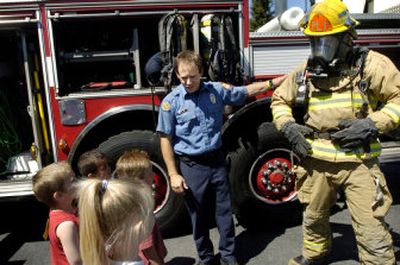
Valley firefighters, other than offering the Fire Stoppers program, concentrate fire prevention efforts on grade school-aged children by visiting nearly two dozen schools during October – fire prevention month. Firefighters talk to second- and third-graders about identifying fire hazards, such as paper too close to the fireplace; and they teach the children about the importance of fire escape plans in the home.
But Thompson doesn’t think that’s enough fire prevention, and the statistics appear to back him up.
Washington fire officials are looking to other states for youth fire prevention models.
“Oregon and Massachusetts are advanced in prevention programs compared to Washington,” Dougherty said.
Oregon has much more in the way of early intervention programs that specifically address reckless burning, residential treatment centers, and programs for those youths who are incarcerated, and prevention education in the schools, said Judith Okulitch, Juvenile Fire Starters program coordinator for the Oregon State Fire Marshal’s Office. Oregon also has the advantage over other states of having dedicated resources at the state government level that help local organizations and “as a result we are putting more resources into place.”
Based on data released earlier this month, Oregon has seen a 38 percent decrease in juvenile-set fires since the year 2000 and a 28 percent decrease from 2003 to 2004.
About one in four fires nationally are set intentionally – and almost half of those fires were set by youth under the age of 18, according to a report by Focus Adolescent Services.
The juvenile fire setters are broken into three groups. The first is mainly boys under the age of 7 who generally start fires accidentally or out of curiosity. The second is children from 8 to 12 years old. Curiosity or experimentation is the main reason this age range starts fires, but for some it represents underlying psychological problems. The third group is adolescents between 13 and 18. These youths usually have a long history of undetected fire play or fire-starting behavior, usually because of other issues in their lives.
In the Valley, juvenile-set fires increase toward the end of the school year and in August when school is about to start back up, Thompson said. The kids get restless during those times of year.
The last arson arrest made in the area was of a kid who thought it would be cool to do some vandalism to this woman’s immaculate yard, Miller said. He was hanging out with some friends when he went up on her porch and started a plastic planter on fire.
It was small in nature, but the behavior is of concern to fire officials.
“It’s a new way to show off,” Miller said. “When I was a kid it was how many cans you could tie to your bicycle.”