
Perfect summer pastime
This is where ballplayers are born.
It’s a lovely spring evening at Pasadena Park Elementary School, and a fleet of parents have staked out a relatively small area of the playground with three rubber squares and a black slab with an adjustable sleeve rising out of a familiar pentagonal shape.
Welcome to the wonderful world of T-ball.
Picture this: a collection of 5- and 6-year-olds all wearing baseball caps that make their profile look surprisingly like a cross between a character from a Peanuts comic strip and a bobblehead doll.
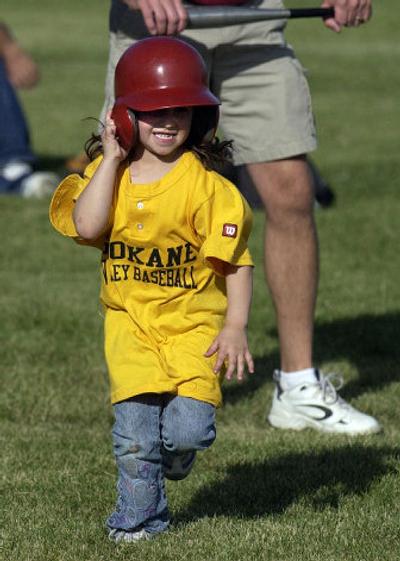
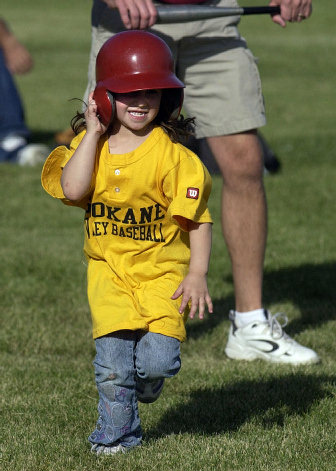
There’s Destiny, for example, an adorable cherub with cascades of naturally curly hair spilling out from under her ball cap. Since Destiny is only slightly taller than the baseball bat she attempts to swing, her jersey has been tied at her waist so that only the word “Spokane” from the full “Spokane Valley Baseball” logo is legible on the Henley T-shirt.
As you look across the makeshift field, the only word that comes to mind is “precious.”
You see a young man decked out in baseball gear. His jersey is tucked neatly into a pair of baseball pants that reach all the way down to his black baseball cleats. His shades give him the look of a major-leaguer and, as he runs out to take the field you see that his batting glove is perfectly tucked into his back pocket, the fingers hanging out so that it looks like he’s waving good-bye.
Unlike other versions of the game of baseball, parents are allowed on the field in T-ball to help encourage the kids, ease any anxiety they might have and to help teach the game.
Coaches mix up the fielding assignments each inning, meaning everyone gets to play every position over the course of a couple of games. That leads to situations like the one that came up at the start of the second inning. The youngster assigned to play first base this half-inning got instruction from three different parents over the course of about two minutes on how to play his new position.
Coaching a T-ball team is a bit like trying to herd cats. Between innings one coach tried to get his young charges to sit according to their batting order, that way each would know when they get to hit. Unfortunately, the lure of a mother’s lap proved overwhelming for a number of players. So did the puppy tethered down the first-base line. And the baby sister getting a diaper change down the third-base line.
That leaves one parent to play traffic cop, making sure the correct youngster makes their way to the plate in the correct order – no easy task. It’s the baseball equivalent of playing “Marco Polo.” The parent calls out “Jake! Jake!! Jake!!!” Jake, his bat trailing out behind him, of course is standing in front of the coach, looking straight up while the search continues. The connection is inevitable, but the scene has a priceless Norman Rockwell quality.
Learning how to field a baseball is priceless.
One shortstop, distracted by the inner construction of his ballcap, discovers the baseball only when it bounces off his leg.
Almost universally, fielding the baseball involves falling down.
Destiny, for example, developed her own style – chasing after the ball, pouncing on it once it stops rolling and covering it with her glove. In her mind, if the ball can’t get away, the play is over.
Young Steele, playing third base, makes a solo play, picking up the ball and running to his base to make an out. To celebrate, the youngster goes into one of the best Tiger Woods impressions you will ever see. He dances across the infield, pumping his fist up and down, before retiring to the comfort of his mother’s lap.
Batting styles vary, depending on the size of the player relative to the size of the bat. Needless to say, the batting tee needs to be reset frequently.
Running to first base after hitting the ball is not an automatic. This game, the home plate parent encourages everyone to “Run like a cheetah! Run like a cheetah!” This causes more than one player to offer the parent a cockeyed look before taking off in the proper direction. Well, the proper general direction. As often as not, the batter takes a detour along the way, making a serpentine path toward the bag.
T-ball is a cross between baseball and “Short-Attention-Span Theater.”
For the third inning, the coach calls his players into a huddle to send players to their assigned positions. Charles, who is assigned to play the outfield, is busy while the ssignments are handed out and is still on his knees after the huddle dispersed.
“Do you want to play the field this inning, Charles?” the coach asks.
“Yes,” Charles replies.
“Okay, then,” the coach replies. “In that case, I think we need to empty this.”
The oh-so-patient coach reaches down and picks up Charles’ miniature baseball mitt, turns it upside down so that the pile of collected grass sprinkles out like a green shower.
“Okay,” Charles replies, dashing to the outfield, where he resumes his grass collecting.