
Good captains have their ships in shape
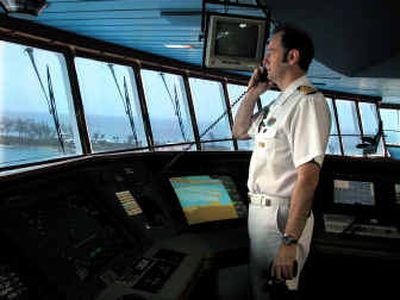
ON THE CARIBBEAN SEA – Attached to the arm of the captain’s chair was a black joystick. With it, the skipper could change the direction of the ship.
I glanced out at the sea. Lazy clouds floated high above the water. Whitecaps skipped across an unending blue panorama. It was a beautiful day on the Caribbean.
I was 10 stories above the sea on the massive bridge of a $550 million cruise ship, one of the world’s largest. On board were nearly 5,000 passengers and crew.
I settled into the black leather chair and grasped the joystick with my right hand. I was now in control of the ship.
Curving in a semicircle in front of me was a huge, Starship-like control panel. Red and green lights winked at me. Monitors blinked with radar blips. Nautical charts came to life on video screens. Hundreds of switches and buttons beckoned.
OK, so I was never really in control. But I was sort of a pseudo captain on a weeklong Royal Caribbean International cruise.
The real master of the ship, Capt. Carlos Pedercini, let me tag along for a behind-the-scenes look at a very big job on a very big ship. His vessel, the Explorer of the Seas, is 1,020 feet long – second only to Cunard’s Queen Mary 2 in size. Placed on its end, it would be nearly as tall as the Empire State Building.
Cruise ship captains are part father figure, part social guru, part navigator and part boss. The downside of the job is that they could end up going down with the ship.
But with such awesome responsibility come some perks. There’s the celebrity factor, for one. Captains are popular guys.
“Guests wish to see and meet the captain,” said Pedercini, a tall charmer from Argentina. “They want their pictures taken with me. They want to talk with me. They want me to be where they are.”
That was how I first spotted him. Pedercini was the center of attention at a picture-taking session on the Explorer’s Royal Promenade deck – a flashy shipboard mall.
Crowding into line were a half-dozen couples who wanted to have their photos taken with him. The dress code that night was formal, and the women were in silver-sequined tops, ill-fitting old prom dresses, beaded trouser suits and faded bridesmaid’s gowns. In their dark suits, most of the men looked uniform by comparison.
Pedercini left the line to bound onto a stage above the mall after a trumpet fanfare and a few chords from “Don’t Cry for Me, Argentina.” He cracked some jokes – “I am the master of the Explorer of the Seas, and I have my wife’s permission to say so” – and introduced his top officers, each honored with a few chords from their national songs.
The audience gave the captain its rapt attention, laughing at his jokes and loudly applauding his comments. There was no doubt about it: He was the evening’s superstar.
Pedercini admitted later that he enjoys the role, “but I’m not a real celebrity. When I get off the ship, no one knows who I am. Real celebrities can never get away from it.”
At 40, he is the youngest captain in the fleet and “the only crazy sailor in my family.”
The Explorer sails every Sunday from the Port of Miami, returning the following Sunday. The captain unloads one group of 3,000-plus passengers before noon and takes on another group after noon, with no time off.
“It’s like every day is a Monday,” he said, a bit wearily. But he was smiling.
It helps that his wife and 18-month-old son are onboard with him part of the time. And there’s always vacation to look forward to: He rotates with another captain, working 14 weeks, then receiving 14 weeks off. It’s enough time to go home to Buenos Aires.
Last fall, he drew the short end of the stick with his schedule, however. His 14 weeks at the helm coincided with the four devastating hurricanes that swirled through the Caribbean. He was at sea, responsible for his ship and thousands of passengers and crew.
What did he do?
“I ran away,” he said without hesitation, describing anxious dashes across the West Indies archipelago to avoid the storms’ paths.
“I will not take any chances. Some guests don’t understand, especially those who come from the middle of the country and aren’t used to the ocean. They say, ‘I was supposed to go to these ports.’ But when there are storms like those …”
He left the sentence hanging. “Safety is my primary concern,” he said.
Our cruise was mellow: Good weather, fair winds. Nice ports – St. Maarten; San Juan, Puerto Rico; and Nassau, Bahamas – joined St. Thomas, U.S. Virgin Islands, on our itinerary. And there was plenty to do onboard: ice skating, rock climbing, miniature golf.
The most dangerous thing the captain faced may have been trying to avoid bumping into other cruise ships. During the prime winter cruise season, they are everywhere in the Caribbean. When we docked at Philipsburg, St. Maarten, nine large cruise ships were in the harbor with us, disgorging 30,000 people onto the 37-square-mile island.
“I don’t go ashore during the winter,” Pedercini said. “Too many ships, too many people. In the restaurants, in the stores, everywhere.”
While passengers were elbowing one another out of the way on land, the captain and crew took care of business on the ship. Some tasks were boring; some were corporate. A “results-oriented management meeting” on Wednesday morning was both.
When he wasn’t needed elsewhere, Pedercini roamed the passageways, checking frayed carpeting in the photo shop, the temperature of the refrigeration unit in the milk storeroom, the condition of the lines around the bollards on the dock. And he was on the bridge whenever the ship entered or left a port.
“As the level of risk increases, we increase staffing on the bridge,” he said as the Explorer sailed toward San Juan.
Only two officers and an assistant are needed on a calm day at sea when conditions are considered “green.” Six people are required on the bridge when conditions turn “red,” as they do when the ship enters a port.
Thirty minutes before the ship’s anticipated docking time, he briefed the officers and listened to a weather report. “Stay alert,” he cautioned them. “San Juan is full of surprises. We’re in condition red.”
The entrance was smooth. Unfortunately, exits often aren’t. And often it’s the passengers’ fault. Many of them ignore the dictum to be onboard 30 minutes before departure. In Nassau, 200 people hadn’t returned by the deadline.
We watched from the bridge as latecomers returned: A few were running to make it in time but most strolled leisurely, shopping bags in hand. The officers did a slow burn.
“Ten years ago, people weren’t like this,” Pedercini said. “They returned on time. I don’t understand. People don’t come to an airport late and expect the plane to be waiting for them.”
“We burn 10 tons of fuel an hour,” Staff Capt. Frank Martinsen said. “We can’t wait.”
And often they don’t. “I don’t choose to leave anyone behind. They choose not to sail with us,” Pedercini said.
Fortunately, everyone made it that day, and bridge staff members relaxed and prepared for departure.
“Do you want to push the button?” Pedercini asked me. “Hold it for 10 seconds.”
I flew across the room, holding my breath. It was my big moment. I stood up straight and reached for it. I counted 10 seconds as a deep, resonant blast echoed across the water.
“Perfect,” the captain said, nodding at me.
I danced around the room as the officers laughed at my excitement.
I may not have steered the ship, but I did honk the horn. And that’s more than most can say.