
Battle lines drawn over Wal-Mart
PULLMAN – A familiar battle is raging in Pullman, as it has in cities across the country.
The nation’s largest retailer, Wal-Mart, is planning to buy 27 acres in Pullman and build a 223,000-square-foot Supercenter. The mall-sized store would be by far the largest retail establishment in the city of 25,000 people, and would include a supermarket, tire center, beauty salon, restaurants and other services.
In response, a grass roots opposition group calling itself Pullman Alliance for Responsible Development has grown to almost 200 strong over the past three months. The group says members range in age from 19 to 81 and include Washington State University professors, farmers, businesspeople, students and homemakers. They’ve developed a Web site and collected the signatures of almost 6,000 people who pledge never to shop or work at the Wal-Mart, if it’s built.
On Friday, the group held a news conference to release a 27-page report detailing the damage they say Wal-Mart inflicts on small communities. It breaks down the alleged increase in traffic congestion, crime and poverty that they say will result from a Pullman Wal-Mart. The study also says Wal-Mart strives to drive its competitors out of business, pays its employees wages below the poverty level and drains tax dollars due to the increased demand for public services.
“Wal-Mart gives a nickel and takes a dime,” said Leland Glenna, a WSU sociology professor and one of the report’s authors. “Pullman will likely see a net loss in jobs and a decline in wages” if Wal-Mart is built.
However, a Wal-Mart spokesman said the company has received thousands of comments in support of the proposed store. The company mailed out 9,000 comment cards and has received 6,000 back, said Eric Berger, Wal-Mart’s regional community affairs manager in Seattle. About 4,000 of them said they want the store, he said.
Many of the comments were from Pullman residents who drive to the Moscow Wal-Mart, eight miles away in Idaho, Berger said. They say they’d like to keep their shopping dollars in Pullman, he said.
The Moscow store would stay open if a Pullman store is built, Berger added.
Berger said that because some of the alliance’s signature-gathering took place on the WSU campus, it’s not indicative of what full-time residents want.
“We feel we have strong support from long-term Pullman residents that know what’s good for their community,” he said.
However, T.V. Reed, chairman of the alliance, said Pullman residents may not support Wal-Mart if they learned more about the company. The alliance cites a 2004 study of Wal-Marts in California which found that the low wages the company pays cause employees to seek public assistance. Since there are so many Wal-Mart employees, this increases the burden on other taxpayers, the study found. Similar results have been tracked in at least eight other states, the report said.
“We’re subsidizing the workers of Wal-Mart throughout this country and we don’t want to do that locally,” said Chris Lupke, an alliance member.
Berger said the average wage of Wal-Mart employees in Washington is $10.14 an hour. He said he did not know what wages would be at the Pullman Wal-Mart, but that they’d be “about that number.” Wal-Mart’s full-time work week starts at 34 hours, he said, which would make an annual salary at that wage of about $18,000.
“We pay a competitive wage in relation to other retailers,” Berger said.
It’s not clear when the proposed store would be built if it’s approved. It must first undergo environmental and site reviews by the city of Pullman. If either review is appealed by anyone, a public hearing would be held, said Public Works Director Mark Workman.
Last week, more than 75 members of the alliance overflowed the Pullman City Council chambers to protest the council’s lack of oversight regarding Wal-Mart. If a proposed development meets city guidelines, including zoning, the council has no say in the matter. Some of the protesters wore tape over their mouths to decry the council’s silence.
The alliance is calling for the city to adopt five ordinances that could affect Wal-Mart’s proposal, or development proposals in the future. One calls for City Council oversight over all developments above 50,000 square feet. Another requires a full economic impact study for all retail businesses of more than 50 employees. The third ordinance calls for retail businesses to pay employees wages sufficient to handle basic living expenses. The fourth calls for large, privately-held places to allow for free speech and assembly within their property. And the last would require the city to develop a comprehensive traffic safety plan.
The council has not responded.
City residents agreed to additional taxes to build a new hospital next door to the proposed Wal-Mart site, said report author Greg Hooks, also a WSU sociology professor. He said the additional traffic congestion will clog access to the hospital in potentially life-and-death circumstances.
“We taxed ourselves so we could have an accessible hospital,” Hooks said.
Berger said Wal-Mart is “ready and willing to work with the city” to alleviate traffic congestion.
Pullman’s planning department has received between 150 and 200 phone calls, e-mails and letters regarding Wal-Mart, said Planning Director Pete Dickinson. About three-quarters of them were opposed, he said. People contacting the department expressed concerns about traffic congestion, aesthetic issues, the wages Wal-Mart pays and the potential damage to other businesses.
“Mostly they’re from the average person on the street,” Dickinson said. He added, however, that if Wal-Mart follows all the city’s rules and requirements, it will be approved. “We consider it to be just like any other development proposed here.”
Business owners on Main Street seem divided over the proposed store.
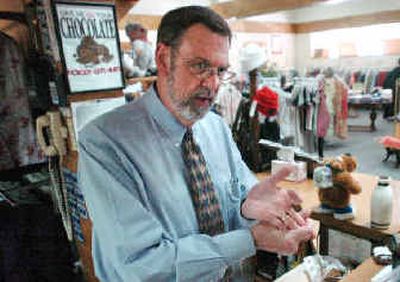
Walk into the clothing store Ken Vogel has run for 22 years at 400 E. Main, and the owner will give you a piece of chocolate and a piece of his mind. He blames Wal-Mart, in part, for driving some of the manufacturers he buys from out of business and worries Wal-Mart will force some of the small businesses in town to close.
“I hate Wal-Mart,” Vogel said. “I’ve never stepped through their doors to shop nor will I ever.”
But down the street at B&L Bicycle Shop, owner Brice Erickson said building a Wal-Mart in Pullman may keep some of the city’s shoppers here, rather than the Moscow store. That could have some flow-over effect for other businesses, he said.
“I think it’s a positive thing for the most part,” Erickson said, standing in the back of a shop crowded with mountain and road bikes sporting higher-end brand names such as Trek and Gary Fisher. “It will keep retail sales tax on this side of the border.”