
Students find pottery class enjoyable, rewarding
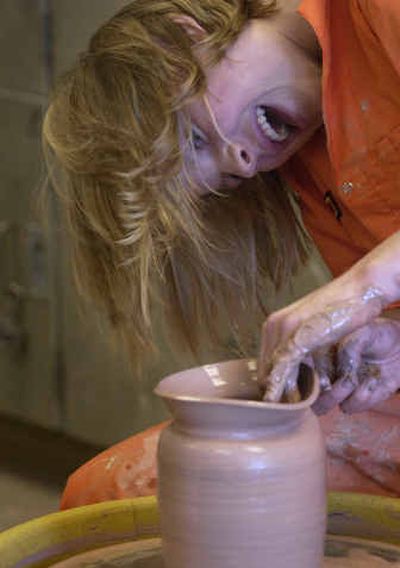
It’s not uncommon to find students sitting behind the pottery wheels at University High School long after the bell rings.
The students in the advanced pottery classes at the school find that throwing clay on the wheel, and getting their hands dirty is an enjoyable and relaxing way to the end of a hectic day.
“I’m not really an artistic person, but pottery is a way for me to express myself through art,” said Layne Brower, 18.
This is Brower’s third year taking pottery at U-Hi, and like many students she keeps coming back, drawn to the simplicity of the medium.
“I can’t paint. I can’t draw. But I can do this,” Brower said. “It’s different than other art forms in that everyone in here can make pieces that can be sold. It’s very rewarding.”
The advanced pottery classes are the most popular electives at U-Hi.
The teacher, Don Ressa, has had to give up his preparation period to teach one more period of pottery each day, he said.
“I end up turning a lot of kids down,” Ressa said. “The kids I do have are so highly motivated. It’s just so much fun to be around them.”
In the advanced pottery classes, the students spend the majority of the class on the wheel, throwing pots.
Students first learn the basic technique of forming a cylinder, and from there they learn to make unique shapes and figures as they perfect and define their own style.
“Different things work for different people,” Brower said.
And it doesn’t come naturally to everyone. Many students have fallen victim to flying clay and muddy water in the eye before creating their first masterpiece.
It took Charlie May three weeks to throw his first pot.
“It was crazy when I figured it out. A total sense of relief,” May said. “Once you get it you get it.”
This year, he’s created between 30 and 40 pots of different shapes, textures and sizes.
“I’m really bad at art, but for some reason I’m decent on the wheel,” May said. “It’s all about the way you decide to shape your pot.”
May talked about a student last year who did “insane abstract things with her pots that made them out of the ordinary.”
Those are the pots that draw the attention of prospective buyers.
“You don’t want to have 30 pots sitting on your mantle that look the same,” Brower said.
Each year on the last day of classes the students create a display of their work, and invite faculty, staff and school board members to come in and view what they have accomplished.
“I’ve had students sell $50 to $75 worth of work at the shows,” Ressa said.
For some students, selling the finished product is not an option.
“I’m kind of attached to my work. Once I’ve spent so much time on it, I kind of grow attached to them,” Brower said. “When there’s no one else around, and you’re alone and what you’re doing and all your energy is focused on throwing your pot, you don’t want to give it away in the end.”