
Altima polishes rough edges smooth
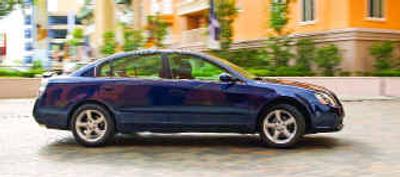
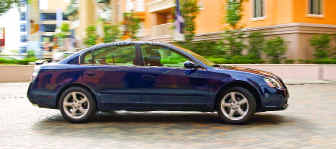
In 2002, Nissan introduced the third-generation Altima and the auto world went gaga.
The Altima had single-handedly restored Nissan’s lost luster, went the refrain. Back in a big way were the crisp handling, communicative steering and potent power plants that had earned Nissan a reputation as the poor man’s BMW.
You can imagine my chagrin when our tester showed up back then; it was a near-stripper that would have been right at home in a rental fleet. Instead of the 3.5-liter, 240-horsepower V-6 Ward’s Automotive has since named one of the world’s 10 best, we drove the 2.5-liter, 175-hp four, a fine engine in its own right but no match for the six-banger.
Adding insult to injury, Nissan had equipped our tester with a four-speed automatic transmission rather than the five-speed stick we would have preferred.
The other big disappointment was an interior swimming in unappealing, low-tech plastic. It wasn’t limited to entry-level models, either, but afflicted the entire product range.
We judged the car fundamentally sound, but, even at its attractive price, felt it ill-prepared to take on the big hitters in its class, which includes the world-class Honda Accord and Toyota Camry.
But, now, three years have passed and Nissan has redeemed itself with a 2005 Altima that’s not quite all-new, but has had enough of its rough edges polished smooth to give it a new lease on life.
On the inside, where the need was particularly great, a redesigned dashboard, instrument panel and gauge cluster are not just good enough, but downright handsome.
In the new Nissan style, the dash and its components are curvilinear, with the audio controls set in an attractive, concave section that’s flanked by generously sized air vents. Three climate-control knobs are aligned horizontally on a chrome-plated panel, an attractive and logical arrangement.
The center console has been replaced, too, and includes a pair of useful cupholders and a large storage bin. A large chunk of dashboard real estate, located just above the audio controls, is set aside for an optional navigation system. When not used for navigation, it becomes another large storage area. Other touches include a new, three-spoke steering wheel, upgraded fabrics and well-placed chrome accents.
Backlit gauges make for easy viewing even in bright sunlight, but a yellow-and-orange-on-black color palette seems an odd choice.
Green-tinted solar-absorbing window glass helps keep the cabin cool and protects interior materials on hot, sunny days.
As before, the seats are supportive and comfortable, and rear-seat passengers have ample head- and legroom. A domestic sedan of similar proportions sat next to the Altima in my garage during my test week and was noticeably deficient in backseat headroom.
The Altima’s rear seatbacks fold down to expand the size of the cargo area, while a pass-through accommodates long, narrow objects.
The trunk proper is plenty roomy, but old-style lid hinges cut into available space.
Nissan has upgraded the exterior with a smoothly rounded front fascia, raised hood and smoked headlights and tail lamps. It’s a sportier, more aggressive look and neatly captures the Altima’s personality.
There’s more punch in the Altima lineup this year, too, thanks to the addition of a new top-end model, called the SE-R (from $29,980, including destination). It gets its own, unique gauge package, dark-chrome trim, leather seating surfaces and xenon headlights. Minor engine modifications bump horsepower to 260 and torque to 251— and a six-speed manual transmission or five-speed automatic, with manual sport-mode, are available.
Other trims include the base 2.5 ($17,930), 2.5 S ($19,780), 3.5 SE ($23,830) and 3.5 SL ($27,630).
The 2.5 is a barebones model that’s available with only the manual transmission. The 2.5 S adds air conditioning; power windows, mirrors and locks; cruise control, keyless entry and audio system with CD player.
The 3.5 SE gets the six-cylinder engine and a trip computer, but loses a few of the 3.5 SL’s features, while the 3.5 SL gets leather seats, automatic climate control and a power sunroof.
Side-impact and curtain-style airbags are optional, as are leather seats, Bose audio system, high-intensity discharge headlights, sunroof and DVD-based navigation system. Traction control is available only on six-cylinder models, while anti-lock brakes are standard on sixes and optional on fours.
On the road, our SL tester provided a stable, solid ride with excellent handling characteristics. The steering is quick and communicative, although it’s a little heavy at center.
The Altima betrays its front-wheel-drive orientation with a display of torque steer under heavy throttle. Chassis dynamics need to be nailed down somewhat before Nissan bumps the power much further, and perhaps should explore an all-wheel-drive option.
The unit supplying that power is one of the best in the business. It has a broad torque range, with a peak of 251 at 3,600 rpm, and pulls strongly from even very low revs.
Our tester was equipped with a very good five-speed automatic transmission – the SL is available only with the automatic. The four-cylinder versions get a four-speed automatic or five-speed stick.
Less than a decade ago, Nissan was $21 million in debt and on life support. Now, flush with cash from its sale to Renault, the company is back to producing comfortable, well-built and fun-to-drive cars. The Altima is a good bet for those who don’t want their cars to be a constant reminder of their need to be responsible.