
Visuals? You bet they had visuals
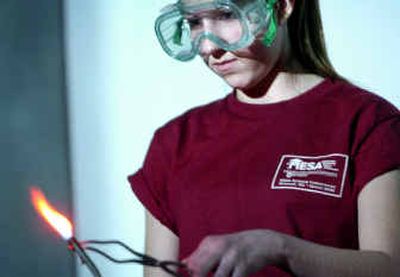
When it comes to science, 3-D beats oral bacteria.
At least it did Tuesday at the annual WSU Spokane MESA Competition for ninth-grade science students from Spokane high schools.
You were probably thinking 3-D is all about wearing those red and blue, cardboard and plastic glasses to some bad movie on Saturday afternoon. So let’s focus here. What it’s really about is subtractive filtration, which fools human binocular vision into perceiving depth.
Just ask Team 1 from Rogers High School. Freshmen students Jessika Myers, Alicia Clarry and Jessica Meese know that even though 3-D was invented in 1838, it did not reach its peak until the 1950s, “the golden age” of goofy glasses.
Their extensive research into this phenomenon won the day on the SIRTI campus Tuesday.
“It was our overall knowledge of the topic,” said Clarry, adding that her team was able to answer any question the panel of judges threw at them.
Of course, it didn’t hurt that the team’s presentation included a cool video clip from “Spy Kids 3-D,” one of those movies a 14- or 15-year-old would probably watch on Saturday afternoon. To almost everyone in the audience, the video looked like you were watching it through a soda pop bottle.
Fortunately, team members had the foresight to equip the judges with the necessary eyewear, and they saw clearly to award Myers, Meese and Clarry the top prize, to the delight of their science teacher, Kristole Roseburrough. For their effort, the three students each took home a Palm Pilot among other gifts.
This was Roseburrough’s first time at MESA (Mathematics, Engineering, Science Achievement), and only her second year of teaching. She led six Rogers’ teams to the competition; most other schools entered eight teams.
Ferris won the award for the high school with the highest average score among all its teams. One Ferris team, calling itself the “Wonka Wannabees,” was among the finalists Tuesday with its presentation on sugar vs. artificial sweeteners in the making of caramel. Take the team’s advice, stick with sugar.
Shadle High School’s Team 6 came in second with “mouth bacteria,” an experiment in the effectiveness of mouthwash vs. brushing alone on the level of plaque-causing germs in the mouth. For the record, mouthwash alone beats brushing with toothpaste alone, but there’s no beating the combination of the two for that clean, fresh feeling.
The other finalists were two North Central teams, one with a presentation on how fireworks work and another with “The Science of Diamonds.”
About 200 students in ninth and 10th grades from throughout Spokane participate in the annual event. The 10th-graders compete Thursday in mousetrap-powered cars. The winning sophomore team will move on to the Washington MESA Day Competition in Seattle on May 24. The national event will be in Irvine, Calif., in June.
Last year, a combined team from North Central and Lewis and Clark won first in state and second in the nation, according to Kirk Reinkens, MESA high school coordinator.
The MESA events in Spokane are underwritten by Agilent Technologies, Avista Utilities, Smith Barney and the Spokane School District.
“It’s good for business,” said Bill Burdick of Agilent. His company sponsors the event in the hopes of attracting more women and people of color to science and engineering. “A diverse work force makes for better solutions to problems.”