
Value-packed Sportage gets much better
Manufacturers are not above slapping a new name on an old car and calling it the second coming.
Leave it to Kia to take the opposite approach. The 2005 Sportage compact sport-ute is new in virtually every detail but soldiers on under the old familiar banner.
Good thing; we’ve only just learned how to pronounce it. (For the record, the emphasis is placed on the first syllable, “sport”; the second rhymes with “edge.”)
The Sportage made its U.S. debut in 1995, hard on the heels of the company’s first North American vehicle, the Sephia sedan. One of the original compact SUVs, it helped usher in the era of the so-called “cute-ute” and was soon followed by the Honda CR-V, Toyota RAV-4, Ford Escape and others.
In the fashion of the times, the Sportage was built on a truck frame. It was cramped and underpowered and all too often betrayed its underpinnings with a washboard ride.
Still, Popular Science called it “Best of What’s New” in ‘95. Four Wheeler Magazine named it one of its “10 Best Buys in 4WD” in 1996, ‘97, ‘98 and 2000; in ‘97, IntelliChoice crowned it “Best Overall Value of the Year.”
The Sportage went on to become Kia’s best-selling nameplate, with more than 250,000 copies sold before the original was phased out in 2002. By then, the parade had passed on and Kia had turned its attention to bolstering the rest of its product line.
After a two-year hiatus, the Sportage has been resurrected. It’s a larger, more comfortable and thoroughly modern, car-based compact SUV. For the first time, it’s available with a choice of two power plants, a 140-horsepower 2-liter four or a 2.7-liter all-aluminum V-6 that makes 173 hp.
As tends to be the case with Kia, the real story line focuses on value. Not only is the new Sportage backed by the company’s 10-year, 100,000-mile warranty, but it also piles on the features.
Even the base LX (from $16,490, including destination) includes power windows, mirrors and locks; AM/FM/CD audio; front and rear power outlets; traction control; and tilt steering.
The array of safety gear is especially impressive. Stability control, anti-lock brakes and a full complement of airbags — front impact, side impact and front-and-rear curtain-style bags — is standard.
For off-roaders there’s even a front skid plate to protect vulnerable under-body components.
All this is just so much frosting on a rig that has become better in every conceivable way.
For starters, the new Sportage is built on a car chassis and sports a fully independent suspension. This configuration produces superior ride and handling characteristics and allowed Kia engineers to make major reductions in noise, vibration and harshness, traditionally the three bugaboos of entry-level sport-utes.
Simply put, the new Sportage is more refined by a quantum leap than the vehicle it replaces.
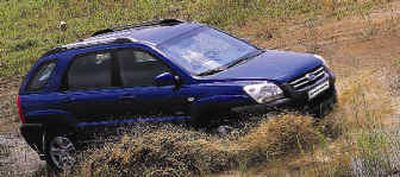
It’s more handsome, too, with familial nods to the midsize sport-ute Sorento. It has a rounded front end with clear-lens headlamps and air intakes sculpted into the front bumper. Flared wheel wells and cladding-free side panels create a strong, upscale look and broad fenders blend into a body-length character line that unifies the whole.
Tom Kearns, the one-time GM stylist who designed the Cadillac CTS sport-sedan, penned the new Sportage.
There’s a newfound sense of maturity on the inside, too. The switchgear feels substantial and operates with a smooth deliberateness usually missing in entry-level rigs, and certainly in the last edition. The gauges are done up in a crisp, readable white-on-black and the controls are easily parsed.
As in the original, a grab-handle is molded into the passenger side of the dashboard, an affectation in a vehicle only moderately off-road-worthy, but worth a few style points. Some of the materials are of a lesser quality, in terms of both quality and design, than those found in more expensive vehicles; it speaks volumes about the industry’s direction that an entry-level vehicle bearing awkward fabrics would also include world-class electronics.
It’s an eminently comfortable interior, with good seats both front and back and plenty of room for four.
An ingenious system of hinges drops the rear seat cushions into the foot-well and folds the seatbacks flat in a single, economical motion.
Most noteworthy are the gains in cabin silence and passenger comfort. Kia made a priority of isolating riders from wind and road noise, as well as vibrations caused by road-surface irregularities. This is where the switch to unibody construction is most relevant: unibodies incorporate body and frame into a single structure, eliminating welds and the attendant squeaks and rattles. And because they resist flex, unibodies also allow for more precious suspension tuning.
Sportage handling lands somewhere mid-pack in a class that’s grown quite good. Pushing it hard through a corner produces predictable but controlled body lean. Overenthusiastic drivers get a certain amount of latitude thanks to the stability control system, which will arrest most skids.
Its short wheelbase (it’s grown to 103.5 inches) means the Sportage suffers the same choppiness over rough surfaces as all small, tall rigs do. But with its new unitbody and fully independent suspension, it has entered the realm of the modern mini-ute.
If the Sportage lacks anything in a serious way, it’s power. Neither the four nor the six is up to class standards, in both cases falling short of the leaders by about 30 horsepower. On the other hand, those same class leaders charge hundreds for essential options that are standard in the Sportage.
Value may remain the most compelling reason for owning a Kia but as the Sportage demonstrates, the vehicles can stand on their own merits. As quality continues to improve, growing numbers of car buyers will discover the benefits of buying Korean.