
Woman fears poachers got ‘pet’ moose
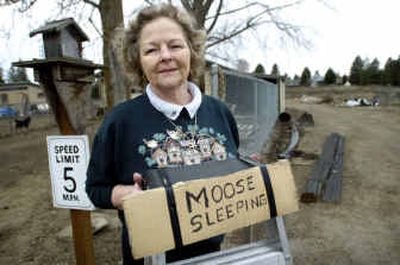
The moose immediately took a liking to Myrna Raney. Either that, or he couldn’t resist her cinnamon buns, even though they were slightly stale and store-bought.
But things haven’t been the same around Raney’s house since her “pet” moose vamoosed. Sure, the 1,000-pound animal wasn’t really Raney’s pet, but he became family in her eyes after wandering onto Edward and Myrna Raney’s property in Mead about seven weeks ago.
She named him Bullwinkle. It wasn’t original, but it was the 70-year-old woman’s first stab at naming a moose. Shortly after she adjusted to Bullwinkle’s schedule – when he ate, when he napped, when he was down for the night – he was gone.
Raney suspects poachers got him. She doesn’t have evidence, but she said it would be too much of a coincidence that she hasn’t seen him since the night she heard four rifle shots about a quarter-mile from her home on North Freya.
“When I heard those shots in the middle of the night I was broken-hearted,” Raney said. “My baby is gone, I’m afraid.”
Moose poaching across Eastern Washington is causing alarm in the Washington Department of Fish and Wildlife.
Madonna Luers, a spokeswoman for the state agency, said five moose carcasses have been found since November around the same region, south of Loon Lake in the Whitmore Hill area. The most recent discovery was last Sunday, but judging by its condition, the moose had been dead too long to be Bullwinkle.
In the past year, 18 moose killed by poachers have been found in Eastern Washington, Luers said. The fine for poaching is up to $1,000 and up to one year in jail. In addition to the fine, the criminal penalty assessed is $4,000 per moose.
Raney first spotted Bullwinkle while he was helping himself to crab apples off her property. Although a country girl from birth, who grew up with pet coyotes and bobcat kittens in the backcountry of Malheur County, Ore., she knows better than to feed wild animals. The temptation was too great.
“I immediately went out,” she said. “He wasn’t afraid of me. He was gentle with me.”
Day-old cinnamon buns followed crab apples.”He just loved the cinnamon rolls,” Raney said. “He’d take them right out of my hand. His little nose was just like velvet. It was so sweet.”
Within a few days, Bullwinkle established a schedule. He’d mosey by around 10ish, and stay until noon. He’d help himself to food, take a snooze and grab another bite to eat. By sundown, Bullwinkle would return to one of two favorite bedding spots in the woods near the Raneys’ house. Raney was more than considerate, posting a “Moose sleeping” sign on her property. She also was especially cautious when the three neighborhood kids came around to see Bullwinkle. She said she’d take them by their hands and let them look from about 50 feet away.
At one point, she said she called Washington Department of Fish and Wildlife shortly before Bullwinkle went missing because she became worried about him living among people. She was told the department doesn’t tranquilize and move a moose unless the animal becomes a menace or danger to anyone in the area.
Luers said Fish and Wildlife is always happy to hear about people enjoying the native wildlife of Washington, but people should remember that moose are wild animals.
“They are not pets, we don’t make them into pets,” she said. “A sure-fire way to turn a wild animal into a potential dangerous pet is to start feeding it.”
Moose also can be dangerous, especially mothers with calves in the spring or bulls that are breeding in the fall. They have been known to charge people.
Nancy Hill, director of Spokane County Regional Animal Protection Service, has had a firsthand experience with a charging moose. She said it happened about seven years ago, when she was helping the Spokane Police Department with a moose that wandered to Francis and Wall.
“A veterinarian was trying to shoot it with a high-powered tranquilizer,” Hill recalled, “The moose came thundering around the house straight at us. There is no way we could outrun a moose.”