
Words fly at national tournament
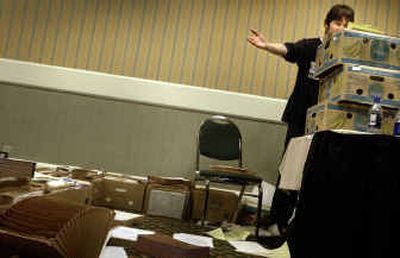
To the untrained ear, it was as if someone dusted off the fast-talking guy from the FedEx commercials of the early 1980s.
To the trained ear, catching every word as the college students at the National Debate Tournament stated their cases – to establish an energy policy requiring a substantial reduction in the consumption of fossil fuels, or not – was an effortless task.
The undergraduates spent four days camped in the windowless conference rooms at the Red Lion Inn at the Park – some downing Red Bull energy drink, others ducking out for a smoke and everyone poring over mounds of research – as the national tournament returned to Spokane for just the second time in its 59 years.
The event, arguably the grandest of all college debate contests, was hosted by Gonzaga University, with finalists University of California-Berkeley and Northwestern University expected to debate late into the night.
The competition began Friday morning with 78 teams from 51 schools that qualified for the trip to Spokane by being nationally ranked, or by performing well at district tournaments. Some universities, such as heavy-hitters Harvard and Dartmouth, were represented by three two-person teams.
The winner receives a trophy and serious bragging rights among the debate community.
Gonzaga’s only team didn’t make it to the elimination round, and the “A” team from Whitman College – the only other Washington school in the tournament – was beaten in the round of 16.
“It is incredibly difficult to win this tournament,” said Eric Slusher, assistant director of debate at Gonzaga. “For those who win, it’s the crowning achievement in their college lives.”
This year’s topic, which students have been debating at district levels since earlier in the school year, was: The U.S. government should establish an energy policy requiring a substantial reduction in the total non-governmental consumption of fossil fuel in the United States.
Eric Morris, coach of Southwest Missouri State University and one of the 200 judges, explained the broad topic has many aspects to explore.
In a semifinal debate, Northwestern eliminated Harvard’s “B” team with Joshua Branson rattling off his arguments at a clip of about 400 words per minute. His only pauses were to gasp for air.
“Once you learn to read fast, you can listen fast,” explained Malcolm Gordon, a motor-mouth himself, representing the University of Missouri-Kansas City.
Gordon, who competed in his second National Debate Tournament, was half of the team that pulled off the tournament upset by beating the Harvard “A” team Sunday night.
UMKC lost Monday morning, during the round of 16.
“You have a limited amount of time and you need to get as much depth in an argument as you can,” Gordon said.
Unlike political debates, Gordon said, “the only way you win is by answering the question instead of sidestepping.”