
Community builds shelter for kids
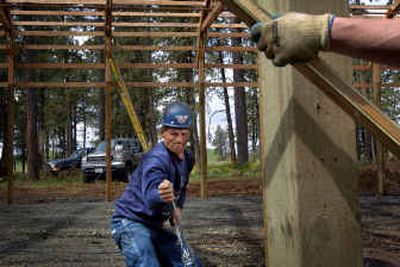

Some communities can still raise a barn.
Harvesting local talent, like framers, electricians and home-improvement hobbyists, the Liberty School District pulled together enough volunteers to erect a 6,000-square-foot framed covered playground for bad-weather recesses.
“If any community could do this, it was this one,” said Duane Reidenbach, district superintendent. “We’ve got a bunch of farmers out here who are used to putting up pole barns.”
After a string of four failed bonds for a new gym and playground cover, the Liberty School District, which serves farming communities south of Spokane, gave up on bonds and built its own playground cover. About 500 students from Latah, Fairfield, Waverly and Spangle attend the Liberty School District.
Roofers were brought in this week to cover the wooden frame with a metal top. They squared up the structure Tuesday with winches. The four sides will be left open.
Reidenbach, whose left thumb was black from taking a hit intended for a nail, looked on. The roof should be up this week and the concrete floor should be poured this month, he said.
In the most recent bond, the playground cover was projected to cost $70,000. That was before a national spike in building materials. Reidenbach did it for about half that price with the community’s help. The Junior Booster Club donated $10,000 to the project, and the Rockford Lions Club donated $500.
There’s some excitement for the playground cover because it gets kids out of the school hallways at recess during rainy and cold weather, said Liberty principal Lori Johnson. The gym is usually filled with classes. Teachers are creative with games and toys, but it’s hard on staff and students, she said.
“Recess is supposed to be a relaxing break time for everyone,” Johnson said.
Eight-year-old Katie McGourin, a second-grader, said recess in the school hallways just wasn’t fun.
“It’s so loud and you don’t get fresh air,” she said.
Katie and her mom helped do their part this past weekend. Using a magnetic roller, they volunteered to pick up errant nails and gathered enough to fill multiple tin coffee cans.
Second-grader Alex Pearson gave the new playground cover an enthusiastic endorsement. “It’s going to be cool. It’s going to be taller than the school.”
The whole project started with a conversation.
School board member Mark Bullock said area contractor Maurice Piersol asked board members if they’d be interested in backing a community effort to get a playground cover done. Reidenbach then went to ask the Spangle Service Club, and Piersol agreed to lead the project. He graduated from the district in 1976.
What helped spur the effort was the way the superintendent approached the service club, said general contractor Brad Green.
“He knows how to ask for stuff,” Green said. “He made us feel like we were part of it. If you make a guy feel like that … everybody wants to be part of something. We got ‘er done.”
To make way for the structure, about 20 trees had to be cut down and removed. That was the first commotion noticed by students who returned to school on a Monday to see a cleared area near the school.
A $28,000 kit provided a pile of timber that needed to be cut and framed together before being hoisted more than 20 feet above the ground. Reidenbach said every volunteer signed a waiver and agreed to wear hard hats.
“We had a lot of people who were doing things they were unaccustomed to,” Bullock said. “You felt a little sore in the morning.”
Art Thayer, a software test engineer at Itron, has been building his home for several years. He cut boards on his table saw for the project and hammered nails for hours on his first day.
“I thought it was a worthwhile project. It kind of reminded me of an old barn-raising thing,” Thayer said. “After about three hours (on his first day), I didn’t know if I could hammer another nail. My arm was just shaking. The next day I brought a lighter hammer.”
The project points to a sense of community that still exists in the fields among small school districts, said Jon Rice, an electrician who helped out.
“Once you get to a certain size, people quit knowing each other,” Rice said.