
”05 Mustang simply the best one yet

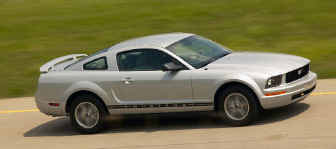
The automotive press fell all over itself in praise of the Mustang last year, when it was introduced as a 2005 model, and buyers have rushed to certify their enthusiasm.
In March of this year, Ford announced it would increase production by 70 percent to satisfy sales that were running 45 percent ahead of last year’s — without the benefit of a convertible, which typically accounts for 30 percent of sales.
All along, the Mustang has been one of the most popular — and recognizable — cars in the country, so what accounts for this burst of enthusiasm?
Quite simply, this is the best Mustang yet, with looks to kill and the first purpose-designed platform in its 25-year history.
With its long hood and short trunk, the original established a design theme still evident in contemporary sports coupes. Ford designers capitalized on that profile this year by extending the wheelbase 5 inches, extending the hood, adding a fastback roofline and raising the windowsills.
Traditionalists are thrilled to see the return of the C-shaped body scoops, the tri-bar taillamps and large headlights.
With near-miraculous sensitivity, designers integrated cues from several generations of Mustang into a harmonious whole. Call it nostalgia without the sentimentality of a purely retro design.
Inside, a broad, flat dash extends the width of the cockpit. Aluminum trim recalls Carol Shelby’s legendary GT500 Mustang, while the speedometer and tach live in deep binnacles, with the other gauges arrayed between them. An option called “My Color” — standard on up-level models — allows the driver to change the colors that light the gauges. Gauge font faces are of an appropriate vintage.
The steering wheel is larger in circumference than most and the rim thinner. Even the hub is smaller than expected, thanks to new space-saving airbag technology.
The only letdown here is the center stack, which includes the radio and HVAC controls; it’s rather pedestrian in appearance, although everything works well and the knobs have a good, solid feel.
Ford has joined the modern age, with seats that provide proper support, although more side bolstering would be welcome in a car that invites aggressive cornering. Larger drivers will feel at home, thanks to increased front-seat legroom, shoulder room and headroom.
The Mustang remains a 2+2 model, though; its back seats are kids-only territory.
Materials and construction are a cut above previous generations and the cabin is commendably quiet.
Not so quiet, however, if one orders the GT version with its 4.6-liter V-8.
This isn’t a new engine for Ford, exactly, but a creative amalgam. The aluminum block comes from high-performance Mustang Cobras, vintage 1996-2002, while the three-valve cylinder heads were lifted from the F-150 pickup.
Ford manages the airflow with composite intake manifolds and cast-iron, semi-header exhaust manifolds; this is a true dual-exhaust, not some ersatz system with twin tips. It sounds like it should, too, with a baritone rumble on ignition and a sustained howl under acceleration.
Horsepower leaps 40 ticks, from 260 to 300, and torque is up to 320 pound-feet at 4,500 rpm.
Two five-speed transmissions are offered, an automatic and a manual. Some linkage wizardry moves the manual shifter closer to the driver and the short-throw box makes quick, sure changes. The throttle is electronic and variable-valve timing spreads the torque across a broad range. The upper-rpm setting comes on seamlessly at about 3,000 rpm and the engine runs hard to its 6,000-rpm redline.
Zero-to-60 happens in just under 5.5 seconds.
A new 4-liter single-overhead-cam V-6 replaces a 3.8-liter pushrod six, making 210 hp and 240 pound-feet of torque.
All this is just icing on the cake, though, for the most profound improvement in the latest Mustang can neither be seen nor heard.
For the first time in its history, the Mustang receives its own platform. The original rode on the Falcon platform which later was upgraded to handle the forgettable Fairmont.
At first it was thought the new Mustang would share platforms with the Lincoln LS and Jaguar S-Type, but finally the decision was made to start with a fresh sheet. Among other techniques, Ford uses full-length “frame-connectors” to increase bending (front-to-back) rigidity by 49 percent and torsional (twist) rigidity by 31 percent.
Greater rigidity reduces squeaks and rattles and allows for more precise suspension tuning, which is especially important considering Ford chose for fiscal reasons to retain a solid rear axle rather than migrating to an all-independent suspension.
Independent suspensions keep all four tires firmly planted, while a solid axle can allow one tire to lift during hard cornering on a rough surface. With just one tire providing traction, it’s not uncommon for a car to skitter sideways.
The old four-link rear suspension has been replaced with a sophisticated three-link system, while beefy anti-sway bars minimize body lean. The system can be pushed beyond its limits, but only with effort.
Steering is precise and quick and, with its longer wheelbase, the Mustang is well balanced entering corners, while initial understeer quickly transitions to manageable oversteer.
Stability control is not available, but traction control arrests most uncontrolled skids.
Ford deserves credit for its new Mustang. Given the car’s past sales success, the company could have taken the easy course, re-skinning the old Mustang and freshening the interior. Instead, they made wholesale improvements and are being rewarded with the kind of sales success no one could have predicted.
Some time ago, Ford declared this the Year of the Car, but they might have called it the Year of the Mustang. Three cheers for a pony car that finally lives up to its reputation.