
Panel quizzes officials on bases
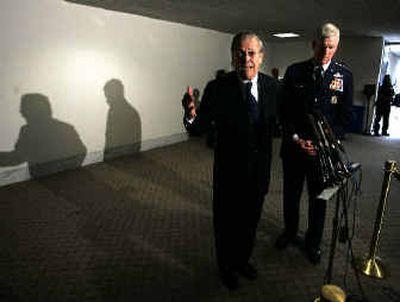
WASHINGTON – A commission charged with reviewing the Pentagon’s proposal to close or downsize 62 major domestic military facilities sounded largely receptive as Defense Secretary Donald H. Rumsfeld testified Monday that the sweeping reorganization was vital to U.S. success in the war on terrorism.
“The changes are essential in helping us win in this conflict,” the Pentagon chief said, adding that eliminating unneeded property to save money for combat capabilities was “more necessary, not less, during a time of war.”
The first round of base closings in a decade seeks to save $48.8 billion over 20 years by streamlining services across the Army, Navy, Air Force and Marine Corps, shutting down bases deemed inefficient, and promoting cooperation among the four branches.
Overall, it aims to restructure a military configured to defend against Soviet threats into one focused on terrorist threats of today.
“If we don’t make some of this happen, we’re going to be stuck in the Cold War mind-set for a long time to come,” Gen. Richard Myers, chairman of the Joint Chiefs of Staff, told the nine-member commission.
With the exception of skepticism over recommended changes to National Guard and Reserve units, the panel sounded open to the overall plan to close or reduce forces at 62 major bases and 775 minor installations. Dozens of other facilities would grow, absorbing troops from domestic and overseas U.S. bases slated for closure or downsizing.
Rumsfeld warned the panel that tinkering with one facility – or trying to “pull a thread” – could cause plans for other parts of U.S. defense to unravel.
“One must be careful about taking a selective look at individual components or pieces of these recommendations without considering how those components or pieces fit into the larger whole,” he said.
Commission chairman Anthony Principi told Rumsfeld that the panel “noted the complexity” of the proposal.
“It’ll make our work harder, but certainly we understand that, and we’ll certainly take it into consideration as we look at the seamless whole and not just an individual military installation,” said Principi, a former veterans affairs secretary under President Bush.
Several commission members praised the Pentagon’s efforts to eliminate redundancy and expenses by consolidating support offices and some operations.
“You’ve made great progress,” said panelist Samuel Knox Skinner, a secretary of transportation under President George H.W. Bush. “I think everybody here supports where it makes sense: joint training, joint logistical work, joint technical work, and all of those things where they are very expensive to duplicate and replicate across this country, and I think you’ve taken a great step.”