
A horse of different size
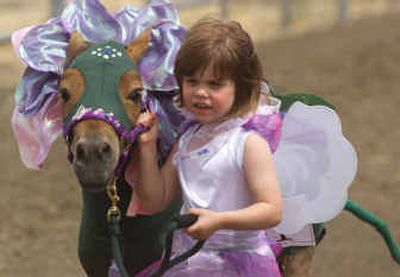

SANTA ANA, Calif. — Yes, miniature horses are cute. But cute doesn’t pay the bills.
That’s what Darrell Dronet told his three young daughters after the girls visited a miniature horse farm and got the adorable creatures stuck in their heads.
“You can’t have one if it’s not gonna work,” he told them. “It’s gotta have a job.”
The family’s other five horses have jobs. They run and jump, with the girls on their backs, winning equestrian competitions left and right.
What could a tiny horse possibly do, other than “stand around and just look cute?” What indeed.
As Dronet soon learned, a small horse can, on occasion, put a big horse to shame. For one thing, they can take elevators. But let’s not get ahead of ourselves.
It was Dronet’s middle daughter, 13-year-old Justine, who discovered the secret life of the hardworking mini horse while watching Animal Planet one day with her Nana. It was a show about pet therapy. Turns out small horses are as gentle as they are cute.
Justine alerted big sister Brittany, 14, and little sister Catherine, 8. The trio joined forces and took their case to their dad. He was skeptical but told them to proceed.
The girls found a woman with miniature horses for sale, but they couldn’t afford the $3,000. She sent the family to a woman in Rancho Cucamonga, Calif., who was selling one cheaper.
Michelle Dhami had bought a half-pint horse named Pepsi Crystal Lite to help her 10-year-old son Benjamin recover after he was hit by a car. Unfortunately, someone called the authorities to complain that the 32-inch-high horse was dragging the neighborhood down, and the woman was given 30 days to find a new home for Pepsi.
A week later, the Dronets showed up. When the woman found out they wanted Pepsi to do therapy work, the kind of work she hoped the horse would do for her son, she hammered out a deal.
The sisters could pay $100 a month to her son’s trust fund for 20 months until the $2,000 horse was paid off. They made their first payment last August. To earn money, they hold garage sales, clean horse stalls, work odd jobs and pool their allowances and birthday money.
They named their venture We Three Sisters and registered as a nonprofit. Through the Internet, the sisters found Solari Hospice Care, a Santa Ana operation that is always looking for volunteers to visit people in the last days of their lives. The hospice has two volunteer opera singers, a pianist, a guitar player, two massage therapists and a caricature artist. Now it’s got a horse.
On a recent Sunday afternoon, the Dronet family drove their trailer from their ranch in Norco, Calif., to a senior apartment complex in downtown Fullerton, Calif. Out trotted a 9-year-old chocolate brown elf of a horse.
“Look at the pony,” came a cry from down the street.
“Look at the little burro,” a woman shouted from a balcony.
Like a circus toy come to life, Pepsi trotted down the sidewalk, led on a short rope by the sisters.
To train Pepsi for visits, the girls let her traipse through their house every day, often with the family cats Carmen and Electra riding on her back. Sometimes they take her down to the road so she gets used to traffic.
“We run and scream past her (and blast heavy metal music like Guns N’ Roses) and she couldn’t care less,” Justine says.
They shave her wooly coat so she doesn’t shed in hospitals or nursing homes. “She was as thick as a bear,” says mom Danielle, 40.
Since she’s not house-trained, the family withholds snacks and water for a couple of hours before visits.
The girls got their pet therapy certification from California’s Orange County Pet Partners.
Since then, Pepsi has nuzzled Alzheimer’s patients at Autumn Years nursing home in Costa Mesa, Calif., and been touched and smelled by blind children at a school in Santa Ana.
On this day she was visiting Raymond Long, a 94-year-old man with prostate cancer and heart disease.
Up the ramp, she went. Then into the elevator. “Easy girl,” Justine tells her as the doors close. “Good girl.”
On the fourth floor, the elevator doors open. Pepsi clip-clops into Long’s room and up to his bed.
“Hello, hello,” Long says, patting her mane. “She’s getting prettier. And more spoiled. Oh, you admit that, do ya?”
Lying in bed under flannel sheets and rumpled covers, Long has a white grizzled beard, wispy white hair and milky blue eyes. He is in good humor but constant pain. “My legs are practically useless,” he says. Meals on Wheels brings him food.
In December, his daughter’s husband found out he had cancer. His other daughter was in ill health herself. Christmas was canceled. Until the Dronets walked through his door with Pepsi.
“These folks came and they made my Christmas,” he says. “I thought it would be so nice if they came to see me again, and they did.”
Long grew up in a Missouri farm community and later traveled the countryside troubleshooting for flour milling companies. So the horse makes him feel right at home. So do the Dronets.
“People in my condition, you’re kind of treated like a second-class citizen. But I’ve never felt that way with them. I feel as though I kind of fit in with them. Just like friends. They have such a nice family spirit. Like the old-timers. When we all got together.
“I think I’m being treated nicer than I should be.”
Nonsense, the sisters say. If anyone is lucky, it’s them. Not only did they get their miniature horse to stand around and look cute. But Brittany says Pepsi has taught her not to be afraid of people who are different. And Catherine says Pepsi has taught her to be patient.
“It keeps us together as a family,” mom says. “And forces us to work together as a team.” Plus, the girls have learned the huge responsibility of people depending on them.
“She’s a little horse,” Justine says. “And she does so much for everybody.”
Even if she’s not exactly paying the bills.